
“Angels We Have Heard on High” Needs Lift, Not Speed
Holiday & Special Occasion Music
By Spiritrax Content Studio · October 23, 2026
Updated October 23, 2026
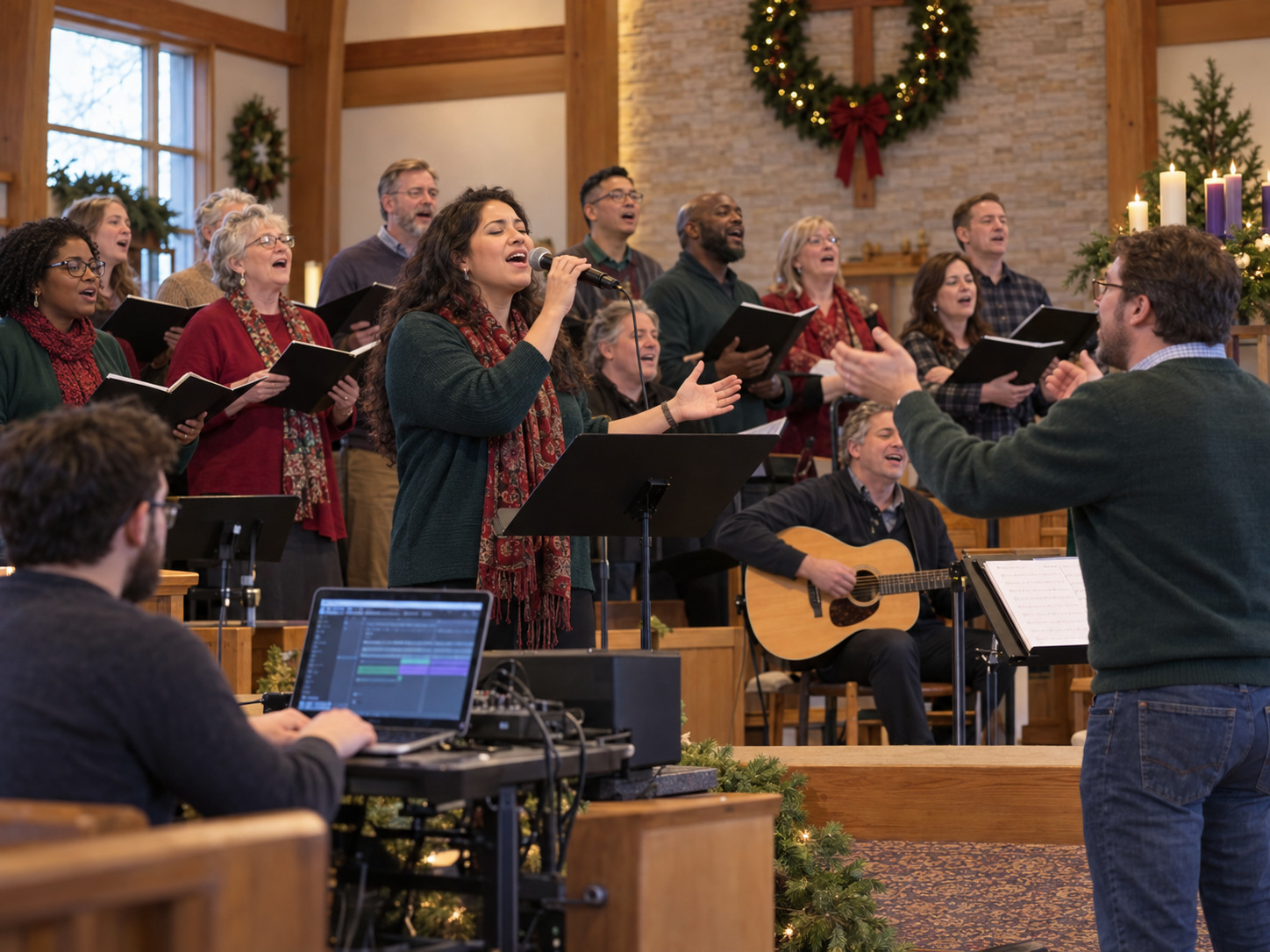
The short answer: choose the key for the people who will sing, then rehearse “Angels We Have Heard on High” with buoyant pulse, clear verse text, one planned breath map for the long refrain, and enough dynamic room for the “Gloria” to lift without becoming faster.
The Spiritrax “Angels We Have Heard on High” backing track is available in F, A, D-flat, and E. Its contemporary arrangement combines acoustic guitar, bass, drums, strings, and solo electric guitar at a moderate tempo, giving a soloist, choir, or worship team a bright foundation without requiring a full live band.
Decide who leads and who joins
The same carol can serve as a solo feature, choir anthem, worship-team song, children's-program selection, or congregational hymn. Name the role before choosing the file.
| Service role | First planning question |
|---|---|
| Soloist | Does the key support the complete refrain without strain? |
| Choir | Can the group align breath, vowels, and the long “Gloria” together? |
| Worship team | Who establishes pulse and who gives the visible entrance? |
| Congregation | Is the key comfortable and the first invitation unmistakable? |
| Special program | Does the arrangement leave enough room for movement and spoken transitions? |
Write the role into the service order. If the choir begins and the congregation joins later, decide exactly when that invitation becomes visible. A familiar carol still needs leadership.
Choose the key from the refrain backward
Spiritrax lists versions in F, A, D-flat, and E. Compare realistic options with the actual singers rather than selecting the original or most familiar key by default.
Begin with the most demanding complete refrain. Check:
- whether upper phrases remain free after several repetitions;
- whether lower verse lines still carry warmth and text;
- whether a mixed congregation can sustain the range;
- whether the soloist or choir can release the last phrase without pushing;
- and whether the selected key works after the voice has already sung earlier service music.
Then sing a complete verse and refrain. A key that feels exciting for one phrase may not serve the whole carol.
Once the decision is made, label the approved file clearly and remove alternate keys from the active playback folder. Changing keys late affects singers, printed music, projections, cue notes, and the sound volunteer.
Keep the pulse joyful without rushing
The arrangement is energetic, but the product page describes a moderate tempo. That balance matters. The music should feel buoyant without forcing the text or turning the refrain into a race.
Have the choir or team mark the accompaniment before singing. Identify the percussion and bass sounds that make the pulse easiest to feel. Step or tap quietly until everyone shares the same subdivision.
Then speak one verse in rhythm. If consonants fall late or the final words of a phrase become crowded, solve the timing before adding pitch.
Use a simple rule: intensity may increase, but the pulse does not. Ask the director or worship leader to show broader phrase direction instead of beating every syllable harder.
Build one breath map for the “Gloria”
The extended refrain is the place where excitement, range, and breath demand meet. A group without a shared plan will either clip phrases, breathe at different times, or accelerate.
Rehearse the refrain in four steps:
- speak the text in a steady pulse;
- sing lightly on one comfortable vowel;
- add the text while keeping the same breath points;
- restore full tone without changing tempo.
For choir, choose coordinated breaths or planned staggered breathing. Do not leave the decision to chance in the service.
For congregational use, let the leader carry through the points where ordinary voices may breathe. The room does not need everyone to sustain the same phrase perfectly; it needs a dependable musical path back into the next entrance.
If singers repeatedly run out of breath, check tempo, key, and phrase planning before asking for more volume.
Let the verses tell the story clearly
The refrain is memorable, but the verses carry the narrative. Keep the words in front of the arrangement.
For each verse:
- agree on the opening consonant;
- mark breaths that preserve complete thoughts;
- align final consonants so releases do not smear across the pulse;
- identify one important word or idea rather than accenting every syllable;
- and decide whether the delivery invites listening or participation.
Run the verse once at a moderate dynamic while the sound volunteer listens from the room. If text disappears, lower playback or clarify consonant timing before adding microphone gain.
The verse and refrain should have different shapes. Let the verse create direction and the refrain release that energy. Repeating the same maximum volume from the first entrance leaves nowhere for the carol to grow.
Use the arrangement's colors as landmarks
Acoustic guitar, bass, drums, strings, and solo electric guitar give singers several sounds to follow. Choose only the landmarks that are reliable in the actual room.
Ask:
- Which instrument makes the first entrance easiest to hear?
- What sound confirms the return from verse to refrain?
- Where does the string texture widen the phrase?
- Which rhythmic sound keeps the group grounded during a long vocal line?
- What musical event confirms the final release?
Name cues in plain language on the run sheet. “Enter after the guitar pickup” is more useful than an approximate timestamp, especially after a rehearsal restart.
Do not let the arrangement become louder than the people leading it. The instruments should make the map clearer, not turn the choir or congregation into background sound.
Balance choir, leader, and playback in the room
Headphones and laptop speakers cannot prove sanctuary balance.
Run the track through the actual system while one listener moves to the front, middle, rear, and side seating. Check:
- whether singers hear enough pulse to enter together;
- whether the congregation hears the words;
- whether drums and bass feel supportive rather than heavy;
- whether guitar and strings stay clear without becoming sharp;
- whether the leader's microphone gives direction without overpowering the choir;
- and whether the final refrain has dynamic room to lift.
Lower playback before asking singers to push. In a reverberant sanctuary, rhythmic detail may blur. In a dry room, the track may feel close and exposed. Use the room you actually have.
If a live guitarist joins the backing track, listen for duplicated parts and frequency buildup. The musician should add a clear role rather than doubling the recording automatically.
Plan participation verse by verse
A Christmas service often includes visitors who do not know the local worship routine. Make participation visible and simple.
One practical plan might be:
- verse one led by soloist or worship team;
- first refrain with choir;
- later verse with congregation invited;
- final refrain with the fullest appropriate sound;
- a clear ending followed by silence, prayer, or the next reading.
This is only a model. Choose a plan that fits the congregation and service.
Rehearse every handoff. The choir should know when it stops modeling and starts supporting. The leader should know when to turn focus toward the room. The sound volunteer should know whether a microphone or playback-level change accompanies the transition.
Give the sound volunteer one dependable cue plan
The fixed track should make the service calmer.
Provide:
- exact approved filename and key;
- service-order position;
- cue owner and plain-language
GO; - first audible landmark;
- intended starting level;
- participation plan by verse;
- any microphone or level change;
- final release and next action;
- and a tested local backup.
Download the file before the service, silence device notifications, and test the real cable, mixer channel, speakers, and backup device. Keep unused keys and rehearsal copies outside the active folder.
If the service needs a different key, tempo, cut, repeat, or ending, identify the exact musical and service requirement before requesting a custom change. Spiritrax offers customization from the product page.
A focused 25-minute rehearsal
Minutes 1–5: compare keys
Sing the complete refrain and a full verse in realistic keys. Choose for the actual singers and service role.
Minutes 6–10: settle the pulse
Mark the accompaniment, speak verse text in rhythm, and name the most useful instrumental cues.
Minutes 11–15: map the refrain
Agree on breath points, vowels, consonants, and the release. Repeat without speeding up.
Minutes 16–20: test participation
Run the planned solo, choir, worship-team, and congregational handoffs.
Minutes 21–25: rehearse the service moment
Begin from the spoken introduction, use the actual playback cue, and continue past the ending into the next action.
Final checklist
- The service role is clear: solo, choir, worship team, congregation, or program feature.
- F, A, D-flat, and E were compared where practical.
- The chosen key fits the complete verse and refrain.
- The moderate pulse stays buoyant without rushing.
- The “Gloria” has an agreed breath map.
- Verse words remain clear over the contemporary arrangement.
- Instrumental landmarks support entrances and returns.
- Participation handoffs are visible and rehearsed.
- Playback supports the room without covering the singers.
- One approved file and a tested local backup are ready.
- The ending and next service action are planned together.
- Public performance, recording, streaming, and lyric-use needs have been checked separately.
FAQ: using “Angels We Have Heard on High” with a backing track
Which keys are available?
The Spiritrax product page lists F, A, D-flat, and E. Test the complete refrain and a full verse before choosing.
How do we keep the “Gloria” from rushing?
Agree on the underlying pulse and breath map first. Rehearse the refrain lightly, then add full tone without changing tempo.
Can the congregation sing with this arrangement?
Yes, when the key is comfortable, a visible leader establishes the entrance, and the contemporary accompaniment stays balanced beneath the voices.
Should a live guitarist play with the backing track?
Only when the live part has a clear role. Listen for duplicated guitar textures and adjust the part or balance so the sound does not become crowded.
How loud should the backing track be?
Loud enough to make pulse, harmony, and entrances dependable, but low enough for the room to understand the words and hear a clear live leader.
The most joyful version is not necessarily the fastest or loudest. Choose the key carefully, keep one shared pulse, plan the long refrain, and give the room a clear invitation to sing.
Preview Angels We Have Heard on High in F, A, D-flat, and E, then choose the bright contemporary arrangement that fits your choir, leader, congregation, and service room.
Preview the Four Keys