
Baptism and Dedication Music Should Leave Room for the Family
Planning Guides
By Spiritrax Content Studio · September 10, 2026
Updated September 10, 2026
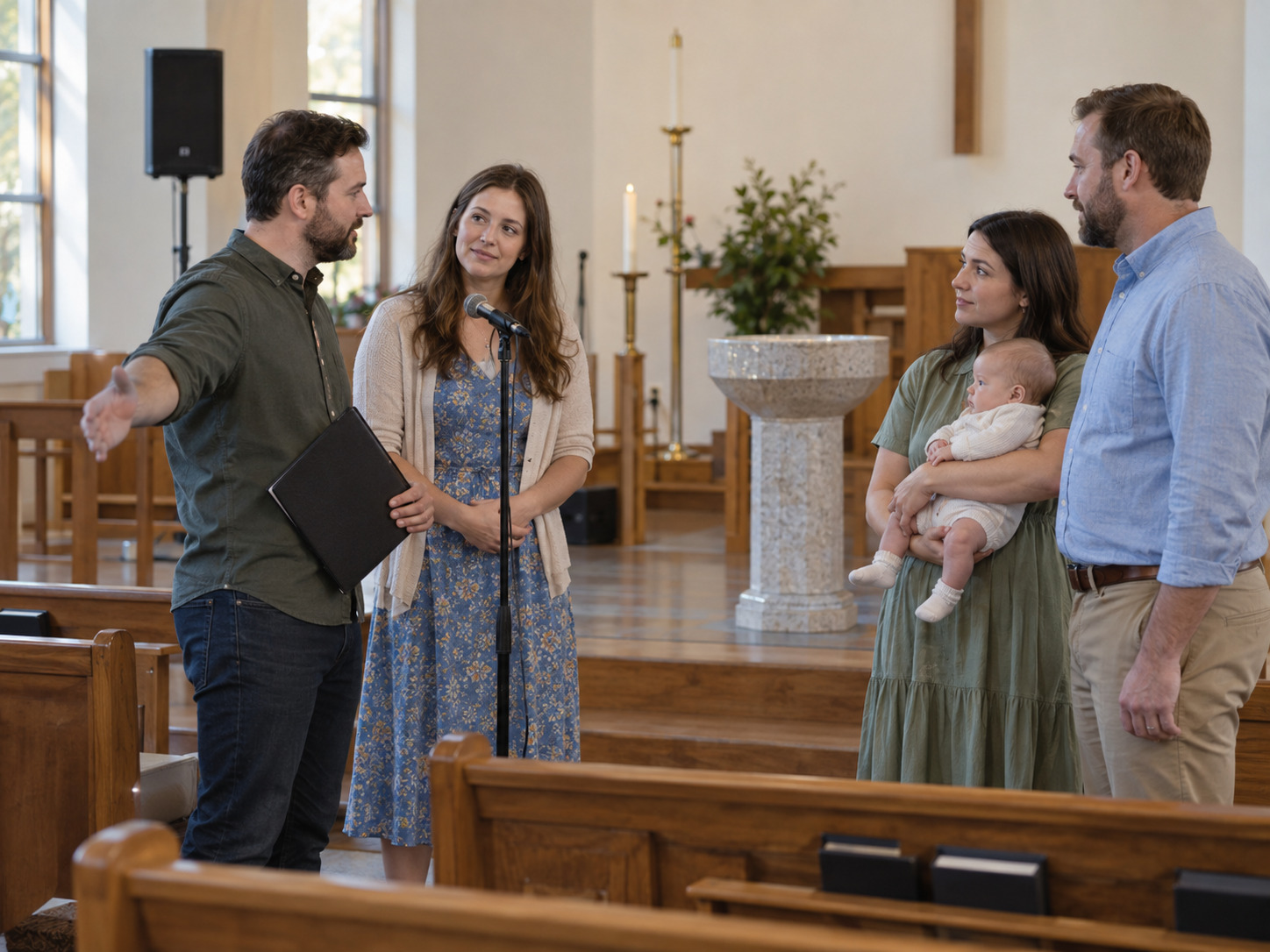
The short answer: choose baptism or child-dedication music by the exact role it will play in the service, then rehearse one comfortable key, one clear start cue, and one ending that leaves the family and congregation room to be present.
Baptism and child dedication are not interchangeable traditions. Churches understand and practice them differently. A congregation may baptize an infant, dedicate a child, baptize an older child or adult, or use another service structure entirely.
The church’s own pastor, worship leader, liturgy, and family-care practices should decide the meaning and order. The backing track has a smaller job: support the selected song reliably without making a personal worship moment feel like a production cue.
Start with the church’s actual service plan
Before choosing a song, ask what will happen around it.
- Is the music for gathering, a procession, a solo, congregational singing, prayer, a family response, or the transition back into the wider service?
- Will one family participate or several?
- Will the song happen before, during, or after the baptism or dedication?
- Does the pastor need silence for spoken words, prayer, or instruction?
- Who is leading: a soloist, choir, worship leader, children’s group, instrumentalist, or the congregation?
- Who can change the plan if a family needs more time?
Do not choose a track only because its title seems related. Choose it because the arrangement, key, length, and emotional shape fit the church’s approved moment.
Give the music one clear job
A family service can become crowded when every meaningful element receives another song.
Use a simple map:
| Service moment | Useful musical job | What to avoid |
|---|---|---|
| Gathering | Welcome the room without demanding attention | Starting too loud while families are being seated |
| Procession or family entrance | Give movement a calm, recognizable pulse | A rigid ending that arrives before everyone is in place |
| Solo or choir selection | Carry one prayerful or celebratory idea | Choosing a key for the recording instead of the singer |
| Congregational response | Make participation easy and familiar | A range or arrangement that turns the room into listeners |
| Spoken prayer or vows | Leave words clearly audible | Continuous accompaniment that competes with the pastor |
| Return to the service | Help the room move together | An abrupt cutoff with no next cue |
One well-placed selection may do more than a long sequence. The family will remember the people, words, and welcome more than the number of tracks used.
Choose repertoire with the family and congregation in mind
Begin with songs already appropriate to the church’s tradition and the family’s service. Then test whether the arrangement supports the intended participation.
A familiar children’s Bible song can work when the service invites warm congregational or family involvement. A hymn may fit a more formal or reflective setting. A solo can hold a focused musical response when the congregation is not expected to sing.
Spiritrax’s Bible Songs backing-track collection includes familiar repertoire arranged for children and group singing. The Jesus Loves Me backing track is available in several keys and uses a lively calypso arrangement. Preview the complete track before choosing it. That bright style may fit a joyful family or children’s moment, but it will not match every baptism, dedication, denomination, or service position.
The catalog is a set of options, not a substitute for pastoral and musical judgment.
Put the song in a key real people can carry
The person selecting the music may not be the person singing it.
For a soloist, test the quiet opening, highest phrase, longest breath, and final line. A key that feels exciting in a short preview may feel exposed after the singer has stood through the service and waited for the cue.
For congregational singing, test the refrain with ordinary voices. If only the worship leader can comfortably reach the repeated high notes, the room will stop participating.
For a children’s group, choose clarity over size. The melody should sit where children can sing rather than shout, while the adult leader remains supportive instead of overpowering them.
When several keys are available, rehearse only the selected version once the decision is made. Remove the other keys from the active service playlist so a volunteer cannot choose the wrong file.
Rehearse the family’s movement, not only the song
The track may begin while people are walking, settling, handing off a child, moving toward a baptismal font or pool, or responding to instructions. That makes the physical sequence part of the cue.
Run the complete handoff once:
- The pastor or worship leader finishes the spoken introduction.
- The family receives the visible or verbal movement cue.
- The operator starts playback only on the named signal.
- The soloist, choir, or congregation hears a clear introduction.
- The music remains below any necessary spoken direction.
- The ending leaves the family in a natural position for the next prayer, welcome, or transition.
If the family needs more time than rehearsal predicted, the service leader—not an anxious operator—should own the decision to wait, shorten, or continue through an approved boundary.
Keep the first cue calm
Many backing-track mistakes happen before the first lyric.
Write down:
- the exact filename;
- selected key;
- service-order position;
- person who gives the start cue;
- length and character of the introduction;
- first singer or group to enter;
- microphone that should be live;
- expected ending;
- next spoken or musical action.
The operator should not have to search among final, new, lower, and use-this files while a family waits in front of the congregation.
Use a plain label such as 04_Jesus-Loves-Me_C_Major_Accompaniment.mp3, then keep the guide-vocal demo and alternate keys in a rehearsal folder rather than the service playlist.
Use guide vocals for learning, not by accident
When available, a guide-vocal demo can help a volunteer soloist, children’s leader, or family learn the melody and arrangement. It is especially useful for confirming the first entrance, instrumental break, verse order, and ending.
Move to the accompaniment-only track before the final rehearsal when the service calls for live singing. That change proves the leader can carry the melody without a recorded voice and prevents a guide vocal from appearing unexpectedly in worship.
The sound operator should receive only the version the service intends to use, plus one tested backup.
Let spoken words stay understandable
If music continues under prayer, family movement, or a pastoral transition, test speech from the room—not only beside the sound desk.
Listen from the front, center, sides, and back. The right level near a monitor may still cover words elsewhere in the sanctuary. Lowering the track is often more useful than making the microphone louder.
Do not assume every quiet moment needs underscoring. Silence may be the better choice during the baptism, dedication prayer, family response, or congregational commitment, depending on the church’s practice.
Plan an ending that serves the next human moment
The song is not finished merely because the audio file ends.
Decide what follows:
- Does the pastor speak immediately?
- Does the congregation remain standing?
- Does the family return to its seats?
- Is there applause, prayer, a welcome, or a congregational response?
- Does the soloist stay at the microphone?
- Should the track land fully, fade at an approved point, or stop before spoken words?
A big button can feel abrupt before a quiet prayer. A long fade can leave a family waiting without direction. Choose the ending around the service handoff rather than the recording alone.
Keep playback simple and private
Family services can include names, schedules, and pastoral details that do not belong in public notes or filenames. The operator needs the service cue, not private family information.
Prepare a simple playback package:
- final accompaniment file downloaded locally;
- identical backup on a second tested device;
- notifications and automatic audio interruptions disabled;
- cable or connection tested in the actual room;
- microphone and speaker level checked;
- guide-vocal and alternate-key files removed from the active playlist;
- short cue sheet shared with the pastor, worship leader, and operator.
If the service will be streamed, recorded, or reposted, confirm the applicable permissions separately before the event. A live-service plan and a multimedia-use plan are not automatically the same.
Baptism and dedication music checklist
Before the service, confirm:
- The church’s approved baptism or dedication order is clear.
- The family and service leader agree on the musical role.
- The selected repertoire fits the congregation’s practice.
- The exact key works for the real singer or group.
- The complete arrangement has been previewed.
- The first cue, introduction, and entrance are rehearsed.
- Family movement and spoken transitions have been walked through.
- Guide-vocal and accompaniment files cannot be confused.
- Speech remains clear if music continues underneath.
- The ending connects naturally to the next service action.
- Primary and backup files are downloaded and tested.
- Streaming or recording permissions have been checked separately when needed.
FAQ: baptism, dedication, and backing tracks
Are baptism and child dedication the same service?
No. Christian traditions understand and practice baptism and dedication differently. Use the church’s own pastoral and liturgical guidance rather than treating one generic plan as universal.
What kind of song works for a child dedication?
Choose a song already appropriate to the church and family, then match its role: congregational response, solo, children’s feature, procession, prayerful reflection, or joyful welcome. Familiarity helps only when the key and arrangement also fit.
Can Jesus Loves Me work with a backing track?
Yes, when the church wants a familiar, lively family or children’s selection and the arrangement fits the service. Spiritrax offers the track in several available keys. Preview its full calypso style before deciding where it belongs.
Should the music play during the baptism or dedication prayer?
Only if the church’s service leader wants it and spoken words remain clear. Many moments are stronger with silence. Decide in advance rather than fading by instinct during the service.
Should we use a guide vocal in the service?
Use a guide vocal for learning when it helps. For live singing, move to the accompaniment-only version before the final rehearsal unless the service intentionally calls for recorded vocal support.
What should the sound operator receive?
Give the operator one final file, the selected key, the exact service-order position, start cue, introduction note, ending plan, next action, and one tested backup. Keep alternate keys and rehearsal demos outside the active playlist.
The takeaway
Music serves a baptism or dedication best when it helps people participate without taking over the moment.
Begin with the church’s actual practice. Give the song one job. Choose the key for the people who will sing. Rehearse the family’s movement and the first cue. Protect spoken words. Plan the ending. Then let a simple, tested playback package support the family, congregation, and service leaders who are already carrying the meaning of the day.
Browse familiar Spiritrax Bible-song backing tracks, preview the complete arrangement, and choose the key and musical style that fit your church’s approved baptism or dedication service.
Browse Bible Song Tracks