
Make “Bring a Torch” Feel Like a Procession, Not a Race
Holiday & Special Occasion Music
By Spiritrax Content Studio · November 9, 2026
Updated November 9, 2026
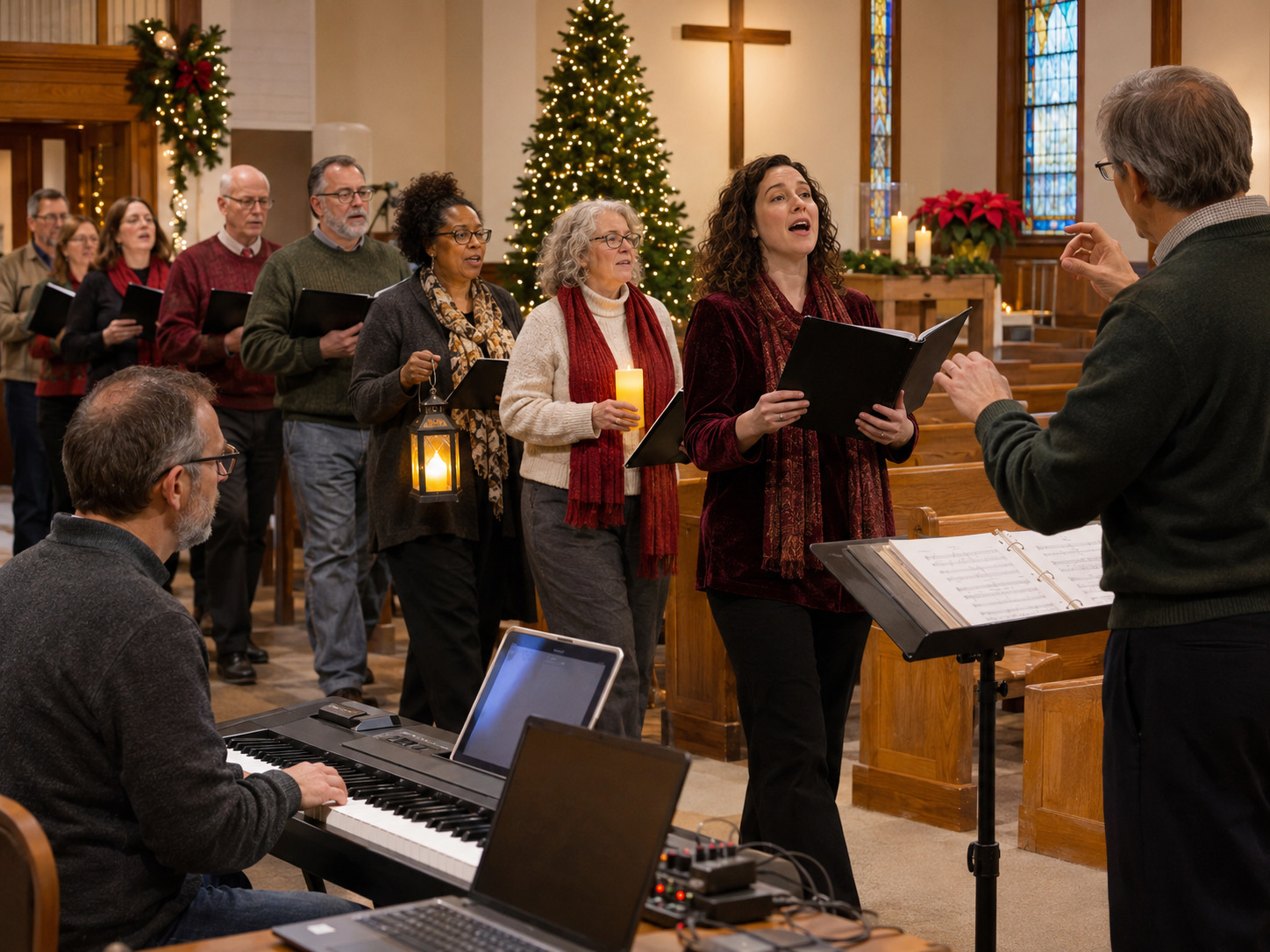
The short answer: treat “Bring a Torch, Jeanette, Isabella” as a gentle procession with a clear destination. Establish the larger pulse, decide who is moving and who is singing, and let the accompaniment’s warm acoustic motion carry the scene without making the people hurry.
The Spiritrax “Bring a Torch, Jeanette, Isabella” backing track is a mellow pop-ballad arrangement with acoustic guitar and soft percussion. It also appears in Christmas Collection Vol. 2 in C major. That sound can support a solo, choir, pageant, family program, or worship procession when the musical and physical cues are planned together.
Choose the job before you choose the movement
The carol can serve several purposes. Name one before rehearsal:
- a quiet entrance for singers or participants;
- a story-centered solo with a choir response;
- a pageant transition;
- a reflective service offering;
- a children’s or intergenerational presentation;
- a bridge between reading, prayer, and music.
The same track should not be asked to do every job at once. A procession needs a dependable walking pulse and safe route. A solo feature needs text clarity and a stable focus. A pageant transition needs clean start and stop cues.
Write one sentence that finishes this thought: “During this song, the room should understand or experience…” Use that sentence to test every staging choice.
Find the larger pulse
Soft percussion can feel busy if singers follow every small sound. Listen for the broader beat that supports breathing and movement.
Try this sequence:
- listen without singing and tap the larger pulse;
- walk the planned route at that pace;
- speak the text rhythmically while standing still;
- sing on a neutral vowel;
- restore the words without increasing speed;
- run the ending into the next service or pageant action.
If the group rushes, give a more visible pulse before changing the recording. Rushing often comes from unclear breathing, nervous movement, or singers chasing the percussion rather than feeling the larger pattern.
Keep a procession from becoming a race
Music can pressure people to move faster than the room allows. Build the route around the slowest safe participant and the real space.
Confirm:
- where movement begins;
- which aisle or path is used;
- how participants enter and exit;
- whether steps, turns, candles, props, robes, or sightlines affect the pace;
- where people stop before singing or speaking;
- who gives the cue if the route is not clear;
- what happens if someone needs more time.
Rehearse the route once without music. Then add the track at performance level. The movement should fit inside the accompaniment without anyone being pulled along by it.
Follow the organization’s established safety, accessibility, candle, and child-participation policies. Music planning does not replace the venue’s movement or supervision plan.
Decide whether the light is literal or musical
The song’s imagery can tempt a production to add candles, lanterns, or handheld props. Those elements are optional.
If the event uses lights, prefer the safest option approved by the venue. Assign who carries them, where they are switched on, how they are held, and where they are placed afterward. Do not introduce a prop at the last rehearsal.
The music can also create a sense of gathering without literal lights. A solo voice can begin the invitation, a small group can join, and the full choir can widen the sound later. That musical progression often communicates movement even when every singer remains in place.
Give the soloist and choir different responsibilities
A story-centered arrangement is clearer when the soloist and ensemble do not compete for the same role.
One possible plan:
| Section | Musical responsibility | Rehearsal focus |
|---|---|---|
| Opening | soloist or small group establishes the story | calm breath and clear text |
| Middle | choir adds warmth or response | matching vowels and pulse |
| Instrumental space | movement or visual focus continues | cue awareness and stillness |
| Final section | widest appropriate participation | balanced growth without forcing |
| Ending | one unified release | next service or pageant handoff |
This is a planning model, not a required arrangement. Follow the approved music and the event leader’s direction. The principle is to give each group a distinct job so that the sound grows for a reason.
Let the accompaniment support the words
Acoustic guitar and soft percussion can create a warm bed under the voices, but text can disappear if the playback level is set from the stage.
Listen from the center, sides, and back of the room. Check that:
- the introduction is easy to hear;
- the first words arrive clearly;
- consonants remain understandable over the percussion;
- the soloist does not have to push;
- lower choir voices are still present;
- movement does not carry singers out of the microphone pattern;
- the ending decays naturally before the next event.
Set the live voices first, then raise the track underneath them. A quiet arrangement can still be too loud when the room is reflective.
Record a short rehearsal from audience distance. Listen once for the story and once for balance. Do not judge the mix only from beside the speakers or keyboard.
Use movement to reveal focus
The audience should always know where to look. If everyone moves at once, the gentle character can become visually busy.
Choose one focal plan:
- the soloist remains still while a small group enters;
- the choir is placed first and the soloist moves into focus;
- participants enter in pairs or small groups rather than one long line;
- movement ends before the most text-heavy passage;
- the final section becomes still and open.
Run the plan without singing. Ask an observer to name the focus at each point. If the observer is unsure, simplify.
Stillness is part of the procession. It gives the audience time to receive the music and gives performers a safe place to breathe.
Rehearse the transitions around the song
“Bring a Torch” may follow a reading, begin a pageant scene, support movement, or lead into prayer. Those edges need as much rehearsal as the song.
Confirm:
- who gives the playback cue;
- whether the room is seated or standing;
- what the soloist sees before the first entrance;
- when movement begins;
- whether microphones or props change hands;
- how the last sound releases;
- who owns the next spoken, musical, or visual event.
Run at least one complete handoff into the track and one complete handoff out of it. Do not stop rehearsal at the final chord.
The Christmas worship-set planning guide can help when this carol must sit beside brighter, more reflective, or more congregational selections. Give each song a different service role instead of letting every number build in the same way.
Prepare the playback operator
The operator needs more than a file name.
Provide:
- the approved purchased file;
- the title and key;
- the event or service name;
- the exact start cue;
- the planned playback level;
- any agreed stop or restart point;
- the next item after the song.
Online previews may contain an audio watermark; use the downloaded accompaniment file for rehearsal and the event. Keep previews, alternate versions, and planning recordings out of the live playback folder.
Disable crossfade, autoplay, notifications, and device sleep. Test the exact cable, output route, mixer channel, and backup device.
Plan recovery without breaking the mood
A movement delay, missed entrance, or prop problem should not force the entire event to restart.
Choose two recovery points:
- one after the introduction;
- one before the final section or ending.
For each point, name the musical landmark, participant positions, visible cue, and first breath. The leader should know whether to keep the track moving, rejoin at the next phrase, or stop for safety.
Safety owns the decision. If the route or prop becomes unsafe, stop the movement even if the track continues.
A 20-minute procession rehearsal
Minutes 1–4: hear the shape
Listen to the introduction, principal transitions, and ending. Tap the larger pulse.
Minutes 5–8: walk the route silently
Test spacing, turns, stops, sightlines, and safe pace without singing.
Minutes 9–12: add voices without movement
Balance soloist, choir, and accompaniment. Keep the text clear.
Minutes 13–16: combine one section
Rehearse only the entrance or most difficult moving passage. Simplify if the focus becomes busy.
Minutes 17–20: prove the handoffs
Run the previous event into the song, then the ending into the next service or pageant action.
Rehearsal checklist
- The song has one clear job in the event.
- The group can feel the larger pulse.
- The route was tested without music first.
- The slowest safe participant sets the movement pace.
- The venue’s movement, accessibility, child, and candle policies are followed.
- Soloist and choir have distinct responsibilities.
- The accompaniment supports the words without covering them.
- Audience focus remains clear.
- Stillness is planned.
- The playback operator has the approved purchased file.
- Online previews are not in the live folder.
- Two recovery points are documented.
- The opening and ending handoffs have been rehearsed.
- The track and any public presentation use the permissions appropriate to the event.
Common questions
What key is included in Christmas Collection Vol. 2?
The collection page lists “Bring a Torch, Jeanette, Isabella” in C major. Test the complete range with the actual soloist or choir before the event.
Does the song require a literal candle procession?
No. The sense of gathering can come from vocal growth, placement, and focus. Use literal lights or movement only when they support the event and meet the venue’s policies.
How do we stop the choir from rushing the soft percussion?
Rehearse the larger pulse, prepare breaths early, and let one visible leader show the beat. Check unclear movement or monitoring before changing tempo.
Can the track be customized?
Spiritrax provides a custom-track route for requests such as key, tempo, cuts, repeats, or endings. Test the standard version first, then describe the exact musical location and event need.
The carol feels inviting when the people have enough time to arrive. Give the track a clear destination, protect the larger pulse, and let movement, words, and accompaniment share one calm plan.