
Let the Candlelight Moment Stay Simple Enough to Sing
Holiday & Special Occasion Music
By Spiritrax Content Studio · August 19, 2026
Updated August 20, 2026
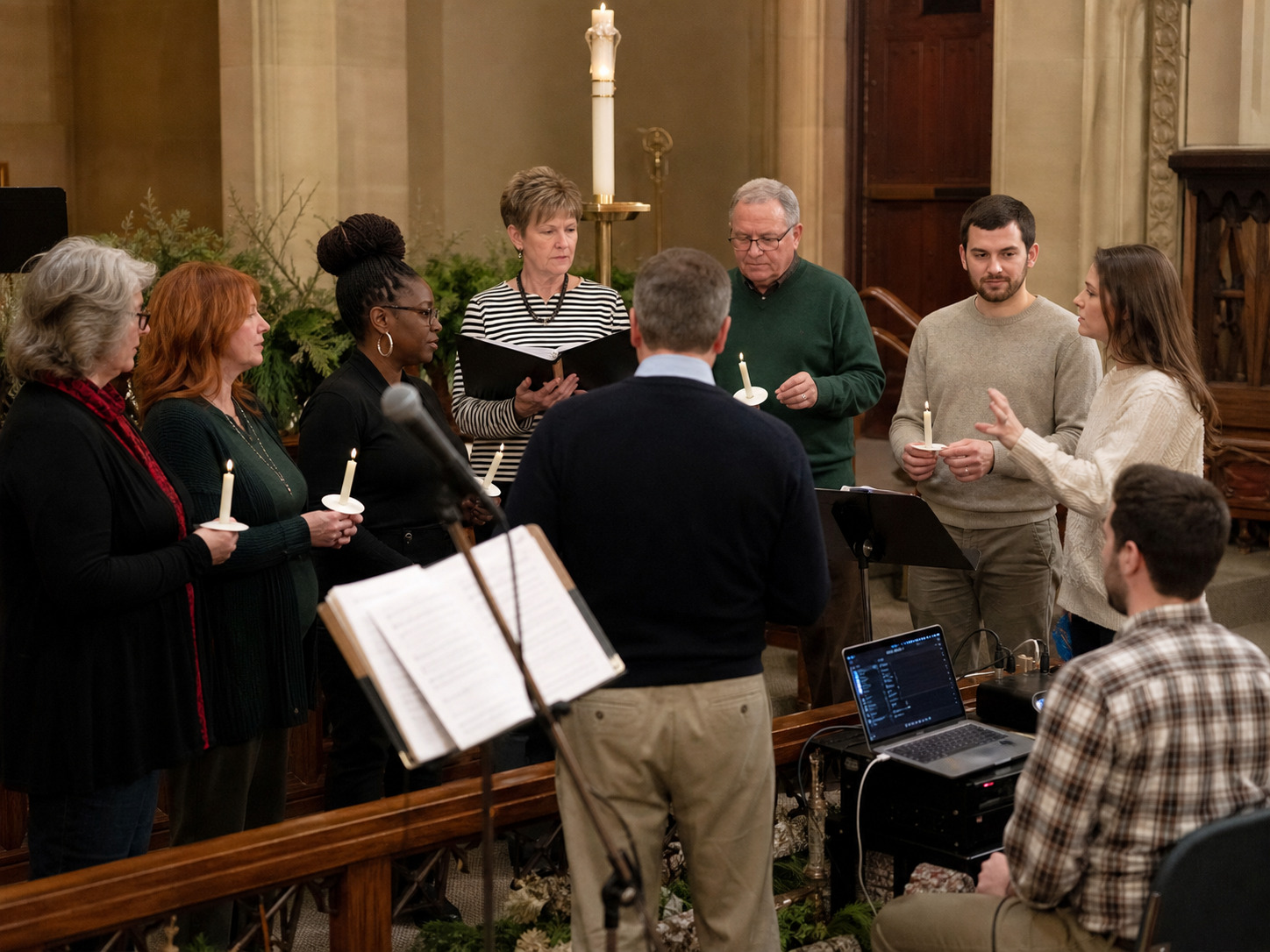
A Christmas Eve candlelight service works best when the music gives the room enough support to sing together without crowding the silence, light, prayer, and spoken story.
Choose a singable key, decide exactly when candles are lit, keep the accompaniment shape predictable, and give the worship leader and playback volunteer the same cue plan. The most memorable moment does not need the most complicated arrangement. It needs a congregation that knows when and how to join.
That preparation matters even when the service uses familiar carols. Familiarity helps people sing, but it does not settle the key, verse order, introduction, candle movement, spoken transition, or playback cue.
Start with the job of the candlelight moment
Before choosing a song, decide what the congregation is doing.
Is the candlelight section:
- the final congregational hymn;
- a response after a reading or sermon;
- music beneath the passing of the light;
- a choir-led anthem that becomes congregational;
- a quiet transition into prayer;
- or the beginning of the dismissal?
Those are different musical jobs. A track that works well for a seated solo may not leave enough time for ushers to share the light. A long instrumental introduction may help candle movement but confuse guests who expect to sing immediately.
Write the service action first. Then choose the accompaniment that supports it.
Choose a carol people can enter confidently
Christmas Eve often brings together regular worshipers, visiting family members, children, guests, and people who have not sung in a congregation for some time.
A useful congregational choice has:
- a familiar melody;
- a comfortable communal range;
- a clear opening pitch;
- a predictable verse structure;
- and words appropriate to the service's pastoral and theological plan.
Silent Night is common because its melody, pace, and text can support a quiet shared moment. Other traditions may choose a different carol. Follow your church's worship leadership and denominational guidance rather than treating one song as universally required.
The key question is practical: can the people in this room sing the melody without straining at the top, disappearing at the bottom, or waiting for a soloist to rescue the entrance?
Pick the key for the congregation
A soloist's preferred key is not automatically the best congregational key.
Test the highest and lowest phrases with the actual leaders. If children, older adults, or a broad community audience will sing, prioritize a range that lets most people participate comfortably.
When evaluating a backing track, confirm:
- the opening note is easy to hear;
- the melody sits in a communal range;
- any modulation remains singable;
- the arrangement does not bury the vocal line;
- and the ending is clear enough for a large room to release together.
If the available key does not fit, use a properly prepared transposition rather than asking the congregation to force the range.
Plan the passing of the light in real time
Candle distribution rarely takes exactly the duration imagined at a planning meeting.
The timing depends on room size, aisle layout, the number of ushers, safety practices, whether candles are already in hand, and how the light moves from one person to another. Follow the venue's fire-safety requirements and use the church's approved candle procedure.
Run the physical action before deciding the music duration.
Measure:
- how long leaders need to receive the light;
- how long it takes to reach the first row;
- when the congregation should begin singing;
- whether the room can remain seated or must stand;
- and what happens if one section takes longer.
A fixed track will not extend itself when the last aisle is still dark. Put flexibility at a boundary: use a separate instrumental prelude, begin the carol after most candles are lit, choose an arrangement with an approved repeatable section, or let live accompaniment cover the variable transition before the backing track begins.
Give each cue one owner
The candlelight sequence can involve the pastor, worship leader, choir director, ushers, projection volunteer, sound operator, and playback volunteer. One person should still own each musical release.
| Moment | Cue owner | Clear signal |
|---|---|---|
| Begin instrumental underscoring | Worship leader or service leader | Named spoken line or visual cue |
| Start passing the light | Head usher or service leader | First approved candle is lit |
| Begin congregational singing | Worship leader | Visible breath, raised hand, or spoken invitation |
| Move to the final verse | Worship leader | Prepared cue before the verse introduction |
| End the track | Playback volunteer following written plan | Completed final chord or named fade cue |
| Begin dismissal | Service leader | Spoken benediction after the music clears |
The exact owner may differ in your church. What matters is that the playback volunteer is not guessing from several simultaneous movements.
Keep spoken words out of the musical entrance
Christmas Eve services often place a reading, prayer, invitation, or safety instruction immediately before the carol. Decide where speech ends and music begins.
Avoid talking over the cue the congregation needs to hear. If the track opens with a short introduction, finish the spoken invitation before playback starts. If words must continue over underscoring, choose music that supports speech and place the congregational entrance after a clear change.
Rehearse the final sentence, the operator's GO, the introduction, and the leader's first breath as one sequence.
Decide the verse order before rehearsal
Do not assume every hymnal, projection file, choir folder, and recording uses the same verses.
Confirm:
- which verses are included;
- their order;
- whether a verse is solo, choir, or congregational;
- whether the accompaniment changes texture;
- whether the final verse broadens or modulates;
- and what words appear on screen or in print.
Then match the lyric display and service outline to the exact recording. A familiar carol becomes hard to follow when the screen advances to words the track is not playing.
Use volume to support, not overpower
A full room of people singing softly can still produce a strong communal sound. The backing track should provide pitch, pulse, and shape without making people feel that their voices do not matter.
Test the balance from:
- the front row;
- the center of the congregation;
- the back of the room;
- the worship leader's position;
- and the playback operator's position.
Listen for whether the introduction is audible, speech remains clear, the melody can be followed, and the final release feels natural. Avoid solving every uncertainty by making the track louder.
Build a simple playback sheet
Give the worship leader and playback volunteer one shared page.
Include:
- the approved filename;
- song title and key;
- number and order of verses;
- whether the file begins with instrumental underscoring or the carol introduction;
- the exact GO line or visual cue;
- the first audible landmark;
- the congregational entrance;
- any repeat, modulation, or texture change;
- the ending type;
- and a recovery instruction.
Use plain operational language. “Start when candles are ready” is vague. “GO after the pastor says, ‘Let us share the light’; eight measures of instrumental music, then the worship leader cues verse one” can be rehearsed.
Rehearse the room, not only the music team
A choir-room rehearsal cannot prove the whole candlelight sequence.
In the actual space, practice:
- the preceding reading or prayer;
- the spoken candle invitation;
- the first playback cue;
- the movement of ushers or leaders;
- the congregational entrance;
- the final verse and release;
- and the transition into prayer, benediction, or dismissal.
Invite enough volunteers to reveal timing problems. The goal is not to simulate every attendee; it is to see whether the planned boundaries can absorb normal variation.
Plan a dignified recovery
Prepare for the ordinary problems that can occur in a live service.
If playback does not start:
- the worship leader waits for the agreed confirmation;
- the service leader does not fill the room with improvised instructions;
- live support begins only if it is part of the approved backup;
- and the operator uses the tested backup device or file.
If candle movement takes longer:
- keep using the planned flexible boundary;
- do not repeat a verse unless that option was rehearsed;
- and let the worship leader cue the congregation from a visible, calm position.
If a verse entrance is missed:
- continue to the next clear musical landmark;
- avoid stopping the entire track unless the recovery plan calls for it;
- and let the leader restore the room with a clear breath and gesture.
Calm recovery protects the service better than an improvised technical explanation.
Christmas Eve candlelight checklist
Before the service, confirm that:
- the candlelight moment has one clear worship and musical job;
- the selected carol fits the congregation and tradition;
- the key is comfortable for communal singing;
- the verse order matches the recording, bulletin, and projection;
- candle movement has been timed in the actual room;
- flexible time sits before, between, or outside fixed playback;
- every musical cue has one owner;
- spoken words do not cover the needed introduction;
- the backing track supports rather than overpowers the room;
- the playback sheet names the file, cue, landmark, and ending;
- the backup has been tested;
- and the complete transition into prayer or dismissal has been rehearsed.
FAQ: Christmas Eve candlelight music with backing tracks
Can a backing track work for a candlelight service?
Yes. It works best when the key, introduction, verse order, cues, volume, candle timing, and recovery plan are prepared around a fixed recording rather than left to improvisation.
Should candles be lit before or during the carol?
Either can work. Choose the sequence that fits the church's safety practice, room, leadership, and worship plan. Test the timing before assigning the track its role.
What if candle lighting takes longer than the track?
Use a planned flexible boundary such as separate instrumental music, a live transition, or a rehearsed repeatable section. Do not assume a standard audio file can wait or extend itself.
Should the final verse be louder?
Only if the service plan and arrangement support it. A broader final verse can be effective, but increased volume should not overwhelm congregational singing or break the reflective tone.
The useful test
Before Christmas Eve, ask: Can a guest enter the candlelight song confidently while the leaders, ushers, and playback volunteer follow one calm plan?
If the key is singable, the physical timing is tested, and every cue has an owner, the music can support the light without becoming the center of attention.
Choose familiar Christmas accompaniment that can support a clear entrance, singable congregational key, and calm candlelight service flow.
Explore Christmas Music Vol. 1