
“For All the Saints” Needs a Procession the Room Can Join
Worship Music & Hymn Resources
By Spiritrax Content Studio · October 20, 2026
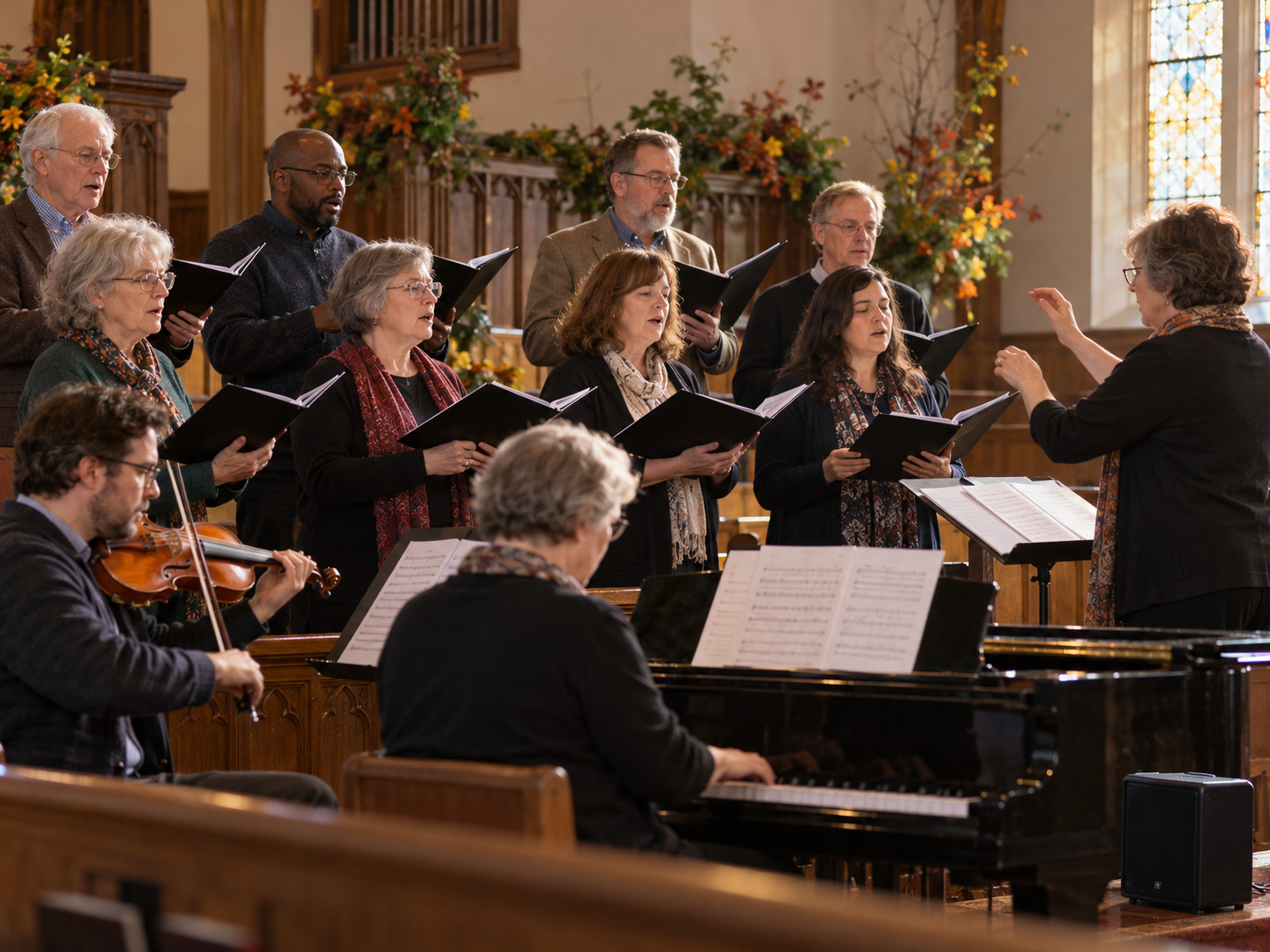
The short answer: rehearse the hymn as a procession of memory, endurance, and hope rather than four identical verses. A clear key, steady pulse, planned leadership, and intentional final cadence help the room sing together while leaving space for the words and the people being remembered.
Spiritrax’s “For All the Saints” backing track pairs vocals with a contemporary solo-piano-and-viola arrangement. It is available in G, E, B-flat, and C major and includes four verses. Those choices give a soloist, choir, small group, or congregation room to find a version that supports the whole service moment.
The useful question is not “Which key sounds most impressive?” It is “Which key lets this room sing the complete hymn with clear words, comfortable breath, and a confident ending?”
Choose the key with the whole hymn in view
Preview realistic keys with the people who will carry the melody. Test more than the opening line.
Use this short comparison:
- Sing the first phrase in each possible key.
- Test the lowest sustained text.
- Sing the strongest phrase after several minutes of rehearsal.
- Listen for unforced vowels and readable consonants.
- Choose the version ordinary voices can sustain through all four verses.
| Primary singers | What to notice |
|---|---|
| Congregation | A middle range that invites participation across voice types |
| Choir | Balanced sections and enough space to shape the text |
| Soloist or cantor | A range that supports expression without pressing the top |
| Small ensemble | A key the lead voice can carry while others join naturally |
The lowest key is not automatically easiest. If the melody sits too low, the room may stop projecting. The highest key is not automatically more triumphant. The right key lets people keep singing when emotion and fatigue are both present.
Hear piano and viola as two kinds of support
The arrangement’s piano and viola can help the room in different ways. The piano provides harmonic grounding and a dependable musical path. The viola can add warmth and a singing line around the text.
During rehearsal, listen once for each role. Ask singers to identify:
- where the piano makes the pulse easiest to feel;
- where the viola encourages a longer phrase;
- where the accompaniment becomes more expressive;
- and where singers must keep carrying the words instead of following an instrumental line too literally.
Then speak one verse over the track in complete thoughts. This keeps the hymn from becoming a sequence of separate syllables. The accompaniment can shape the atmosphere, but the live voices still carry the meaning.
Give each verse a service purpose
Avoid making “a little louder every time” the entire plan. Decide what each verse contributes.
One practical outline is:
| Verse purpose | Leadership choice | Rehearsal focus |
|---|---|---|
| Gathering memory | Cantor or choir establishes key and pace | Clear first word and calm breath |
| Naming endurance | Congregation joins the established pattern | Comfortable pulse and readable text |
| Holding rest and hope | Smaller live texture or more focused choir sound | Long phrase without dragging |
| Sending in confidence | Full room returns | Unified final cadence and next cue |
This is a planning example, not a required interpretation. A congregation may use different verses, readings, names, or ceremonial actions. The principle is to decide how leadership and participation change so that every verse has a reason to be present.
Rehearse the opening from silence
All Saints’ Day services often include spoken introductions, names, prayers, bells, candles, or movement. Those elements can overlap the musical entrance if no one owns the handoff.
Practice the actual sequence:
- Who finishes the spoken introduction?
- Is there a deliberate silence?
- Who starts playback?
- Who gives the visible breath?
- Can singers hear the first pitch without a volume jump?
- Are words or hymnals ready before the entrance?
Choose one visible leader for the first breath. The choir, congregation, instrumentalists, and operator should follow the same cue. A quiet opening can still feel secure when responsibility is clear.
Keep remembrance participation-sensitive
A remembrance service may include people who are grieving, people who rarely attend, and people who know the hymn well. Plan a musical environment that welcomes all three.
That usually means:
- a singable key;
- an introduction long enough to settle but not so long that the room becomes uncertain;
- words available before singing begins;
- a moderate level that supports rather than surrounds the congregation;
- and a leader whose breath and posture are easy to follow.
Do not use volume as a substitute for confidence. If people stop singing, check the key, word access, cue visibility, and accompaniment balance before raising the track.
Plan names, bells, candles, or movement against the track
If the service includes a memorial action, decide whether it happens before the hymn, between verses, under instrumental music, or after the final cadence. Do not assume a fixed track can stretch around an unknown number of names or an unmeasured procession.
Create a simple timing map:
| Service action | Musical location | Owner |
|---|---|---|
| Spoken invitation | Before playback | Presider or worship leader |
| First visible breath | End of introduction | Choir director or cantor |
| Memorial action | Named verse boundary or separate silence | Service planner |
| Final release | Last cadence | Director and operator together |
| Next spoken cue | After the sound has fully ended | Presider |
If the action needs open-ended time, keep it outside the fixed song or use a separately planned musical bed. A track should support the ritual, not force the ritual to rush.
Balance the accompaniment around live voices
Piano and viola can feel intimate, which makes small balance problems easy to hear. Set live voices first, then add enough playback for pitch, pulse, transitions, and ending.
Listen from several seats and ask:
- Are the opening consonants clear?
- Does the piano remain supportive rather than percussive?
- Can the viola be heard without covering the melody?
- Are lower voices still present?
- Does the room keep singing in the gentler verse?
- Is the final build confident without becoming oversized?
If microphones are used, test them with the actual number of singers. A level that works for one soloist may be too much for a choir. A level that feels full near the speakers may be too soft in the back of the room.
Protect the final cadence and the silence after it
The ending is part of the service, not just the end of the file. Decide what the room should do when the final sound releases.
Rehearse:
- the final breath;
- the sustained phrase;
- the director’s release;
- the operator’s confirmation that playback has ended;
- and the silence before the next word or movement.
Avoid starting announcements or movement on top of the last resonance unless that overlap is intentional. A brief shared silence can let the hymn’s confidence settle without turning the moment into performance applause.
A focused 30-minute rehearsal plan
Use one practical call to prove the service moment:
- Five minutes: compare keys with the actual lead singers.
- Five minutes: listen for piano, viola, pulse, and phrase.
- Seven minutes: assign a purpose and leader to each verse.
- Five minutes: rehearse the spoken handoff and first entrance.
- Five minutes: test any names, movement, or memorial action.
- Three minutes: run the final verse, cadence, silence, and next cue.
Finish by naming only the changes that matter for the service: key, start cue, leadership, balance, memorial timing, ending, and next handoff. More notes are not always more useful.
For wider setup help, Spiritrax’s practical guide to worship backing tracks covers keys, rehearsal, playback, and service planning.
FAQ: using “For All the Saints” with a backing track
Which key should a congregation choose?
Choose the key that ordinary voices can sustain through the complete hymn. Test the opening, lower phrases, strongest phrase, and final verse with the actual leaders before deciding.
Can the hymn accompany a reading of names?
It can support a planned memorial sequence, but an open-ended list may not fit a fixed track. Place names before the hymn, at a measured verse boundary, or over a separately planned musical bed when timing is uncertain.
Should every verse become louder?
No. Let leadership, texture, participation, and meaning shape the verses. A reflective verse can become smaller without losing the pulse, and the final verse can grow through shared singing rather than volume alone.
How loud should the track be?
Use enough level for singers to hear pitch, pulse, transitions, and ending while keeping live words at the center. Check the balance from the seating area, not only beside the speakers.
What should happen after the last chord?
Plan the release, a brief silence, and the next spoken or ceremonial cue. The end of the file should feel like part of the service flow.
A dependable track does not remove the human work of remembrance. It gives the room one musical path so leaders can focus on words, participation, and the people gathered to remember together.
Preview For All the Saints in G, E, B-flat, and C major, then choose the piano-and-viola version that helps your soloist, choir, or congregation carry all four verses comfortably.
Preview the Four Keys