
Glory to God Begins Before the Choir’s First Note
Worship Music & Hymn Resources
By Spiritrax Content Studio · September 16, 2026
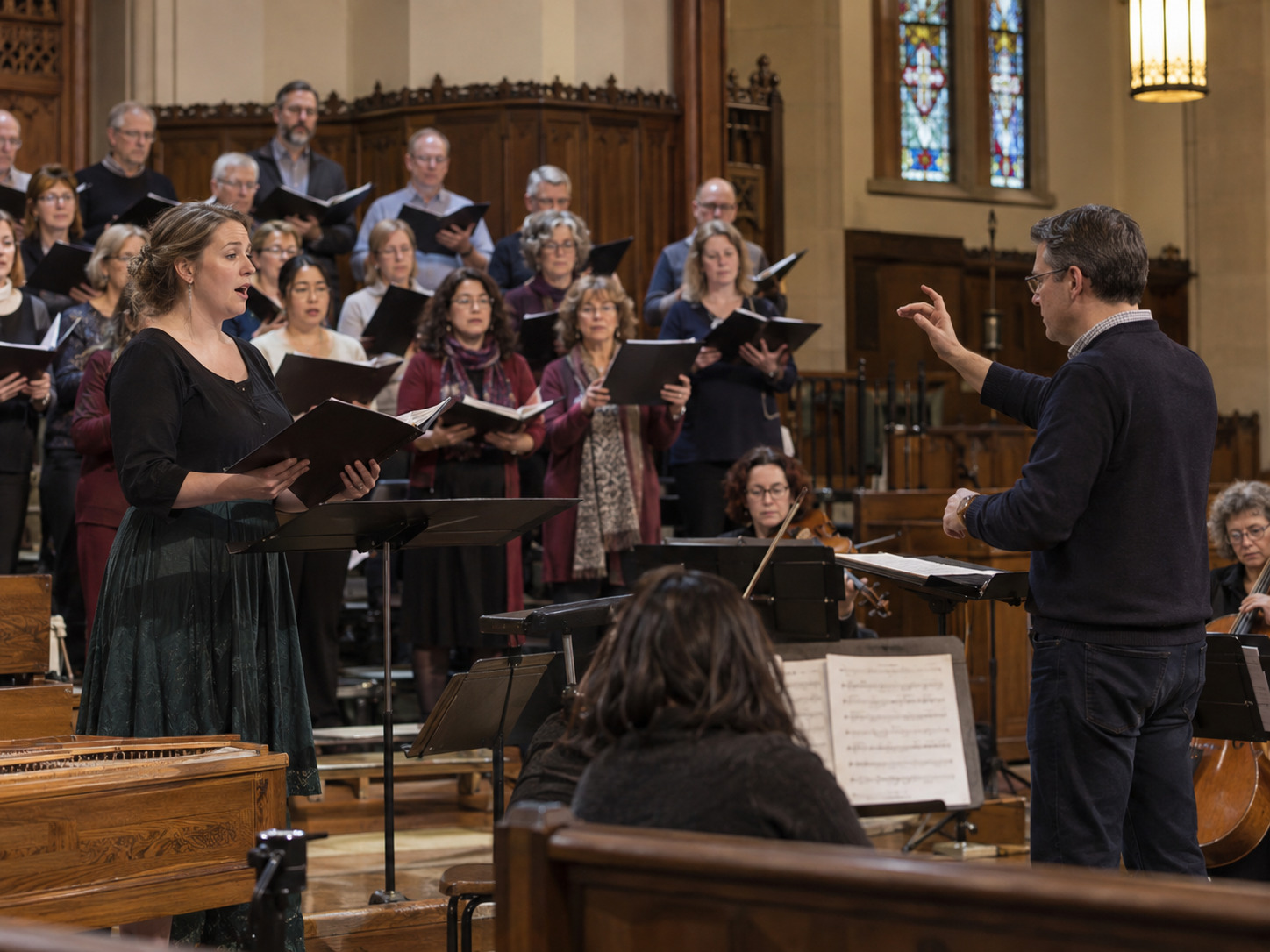
The choir's first note is not the beginning of this track. Spiritrax's “Glory to God in the Highest” accompaniment includes the preceding eight-measure soprano recitative, “And Suddenly There Was with the Angel,” as its introduction.
That makes the handoff the central rehearsal job. The soloist, conductor, SATB choir, playback operator, and sound system must carry one continuous movement from narration into proclamation without guessing where the chorus begins.
Rehearse the file you will actually use
Spiritrax lists the track in D major as movement 17 of Handel's Messiah. The product includes movement 16 as an eight-measure soprano recitative introduction, followed by the SATB chorus with trumpets, woodwinds, strings, and harpsichord.
Preview the exact “Glory to God in the Highest” backing track and confirm the selected file, key, score, and performance plan with the music leader before rehearsal.
Do not teach the choir from a shortened excerpt if the event will use the complete track. Singers need to know what they will hear before their entrance: the recitative's pacing, the final words, the orchestral handoff, and the conductor's preparation.
Give the recitative a real musical owner
The soprano line is not dead time before the chorus. It establishes the scene and prepares the turn into “Glory to God.”
Before combining forces, settle:
- who sings the recitative;
- which score and text the soloist is using;
- how the soloist will hear the accompaniment;
- what the conductor will lead and what remains fixed in the track;
- where the choir begins to prepare physically;
- and what exact sound or gesture releases the first choral entrance.
Run the recitative with the track from the first measure. A singer who learns only from memory may shape pauses that the fixed accompaniment does not share. The goal is not to remove expression. It is to learn where expression can live inside the actual file.
Listen for the end as carefully as the beginning. The final words and accompaniment should hand the room to the choir without a separate restart, a shouted count, or an uncertain pause.
Teach the choir from the handoff backward
The first choral entrance becomes easier when singers know the last complete event before it.
Use this sequence:
- Play the final portion of the soprano recitative without the choir singing.
- Ask each section to identify the last audible landmark before its entrance.
- Practice the conductor's preparation in silence.
- Add the first choral phrase at a moderate rehearsal volume.
- Continue far enough to establish the next musical idea.
- Reset to the recitative and repeat the complete handoff.
Do not stop after one correct attack. The choir must carry the phrase, shape the text, and stay with the orchestral movement after the excitement of the entrance.
If singers enter together but cannot sustain the phrase, the problem is not the cue alone. Rehearse the text, breath, rhythm, and continuation as one unit.
Make “peace on earth” more than a volume change
The text and orchestration ask the choir to move between brilliance and restraint. A rehearsal that treats every section as equally loud can flatten the message and cover the words.
Agree on:
- the energy and vowel of “Glory to God”;
- how consonants stay clear without arriving early;
- how the choir changes color for “peace on earth”;
- which sections carry the musical line at each point;
- where the orchestration is dense enough to require careful balance;
- and how the final release will be shown.
Speak difficult text in rhythm before singing it at full volume. Then add notes at a level that keeps every section listening. Save the largest sound for the places the conductor has chosen, not for the first moment the accompaniment feels exciting.
The accompaniment is orchestral support, not a challenge the choir must overpower.
Balance the soprano, choir, and track in the room
A home speaker test cannot prove sanctuary or concert balance.
Use the intended performance positions and check three listeners:
- the soprano soloist;
- the choir;
- and someone in the congregation or audience area.
The soloist needs enough accompaniment to phrase securely without being covered. The choir needs to hear the recitative ending and its first musical landmark. The audience needs the text to remain intelligible as the orchestration and full ensemble arrive.
Before raising levels, check speaker direction, monitor position, microphone placement, room reflections, and where singers are standing. More volume can make the handoff less clear if it adds spill or masks consonants.
Rehearse with the exact playback device and file intended for the event. Confirm that the operator is not streaming an untested preview, switching between differently named copies, or relying on a connection the room has not proved.
Give the operator one complete cue map
The playback operator needs more than the title.
Provide:
- the exact filename and selected key;
- where the movement sits in the service or concert;
- the event that cues playback;
- whether the soprano is already in position;
- when the choir stands or prepares;
- the choir's first entrance landmark;
- what happens after the ending;
- and where an identical tested backup is stored.
Start rehearsal from the preceding spoken, silent, or musical element. Then continue past the final chord into whatever follows. That is the transition the room will experience.
If the choir is using several Messiah movements, keep them in program order rather than asking the operator to search by title during the event. Spiritrax's Messiah Part 1 collection includes the opening movements through “His Yoke Is Easy” and can provide one source for a broader Advent, Christmas, or concert plan.
A focused 45-minute rehearsal plan
First 10 minutes: listen and mark
- Play the complete track without singing.
- Follow the recitative and first chorus entrance in the score.
- Mark the final solo landmark, conductor preparation, first choir consonant, and first complete phrase.
- Confirm who owns playback and who owns the musical release.
Next 10 minutes: soloist and handoff
- Rehearse the soprano recitative with the exact accompaniment.
- Check breath, pacing, text, and the final transition.
- Add the conductor and choir preparation without singing.
- Repeat until the cue is visible and calm.
Next 15 minutes: choir entrance and contrast
- Sing from the last portion of the recitative into the first choral section.
- Continue beyond the attack so the phrase stays supported.
- Rehearse the contrast between the larger declaration and “peace on earth.”
- Correct text and balance before adding more volume.
Final 10 minutes: run the event
- Begin from the element that precedes playback.
- Use the intended device, speakers, positions, and microphones.
- Run through the ending and the next event.
- Confirm the final file, backup, cue owner, and operator note.
The time may need to expand for the ensemble. Keep the sequence even when the calendar changes: understand the file, rehearse the handoff, build the choral contrast, then operate the complete event.
Decide whether the individual track or Part 1 fits
Choose the individual movement when the program needs this recitative-and-chorus pair by itself. The product page lets the team preview the accompaniment and keep the purchase connected to the exact piece being rehearsed.
Consider Messiah Part 1 when the same program also uses movements such as “Comfort Ye,” “Every Valley,” “And the Glory of the Lord,” “For Unto Us a Child Is Born,” or “O Thou That Tellest.”
The collection does not replace planning. Confirm the exact movements, keys, soloists, score materials, order, and playback notes. If the program needs the full work, Spiritrax also offers The Complete Messiah.
Questions choirs ask
Does the Spiritrax track include the soprano recitative?
Yes. The reviewed product page says the track includes movement 16, an eight-measure soprano recitative, as the introduction to movement 17.
What key is the track in?
The reviewed product page lists D major. Confirm the current product selection and the choir's score before rehearsal.
Can the choir start directly at “Glory to God” in rehearsal?
It can isolate the chorus while learning notes, but the ensemble should repeatedly rehearse from the included recitative so the final handoff is familiar.
Should the choir stand during the recitative?
That is a local staging or worship-planning decision. Whatever the team chooses, rehearse the movement and preparation so standing does not distract from the text or delay the entrance.
Is this only a Christmas selection?
The product page connects the text to Christmas. The worship leader, conductor, or program planner should decide whether it fits the specific service or concert.
The strongest entrance will not feel like the choir was waiting for its turn. It will feel like the recitative opened the scene, the accompaniment carried the transition, and the full ensemble answered together.
Preview the Spiritrax D-major accompaniment that joins the eight-measure soprano recitative to the SATB chorus. Confirm the exact file, score, soloist, choir cue, and room setup before the final rehearsal.
Preview Glory to God