
“O Come, O Come, Emmanuel” Needs a Shared Rubato Map
Holiday & Special Occasion Music
By Spiritrax Content Studio · October 16, 2026
Updated October 16, 2026
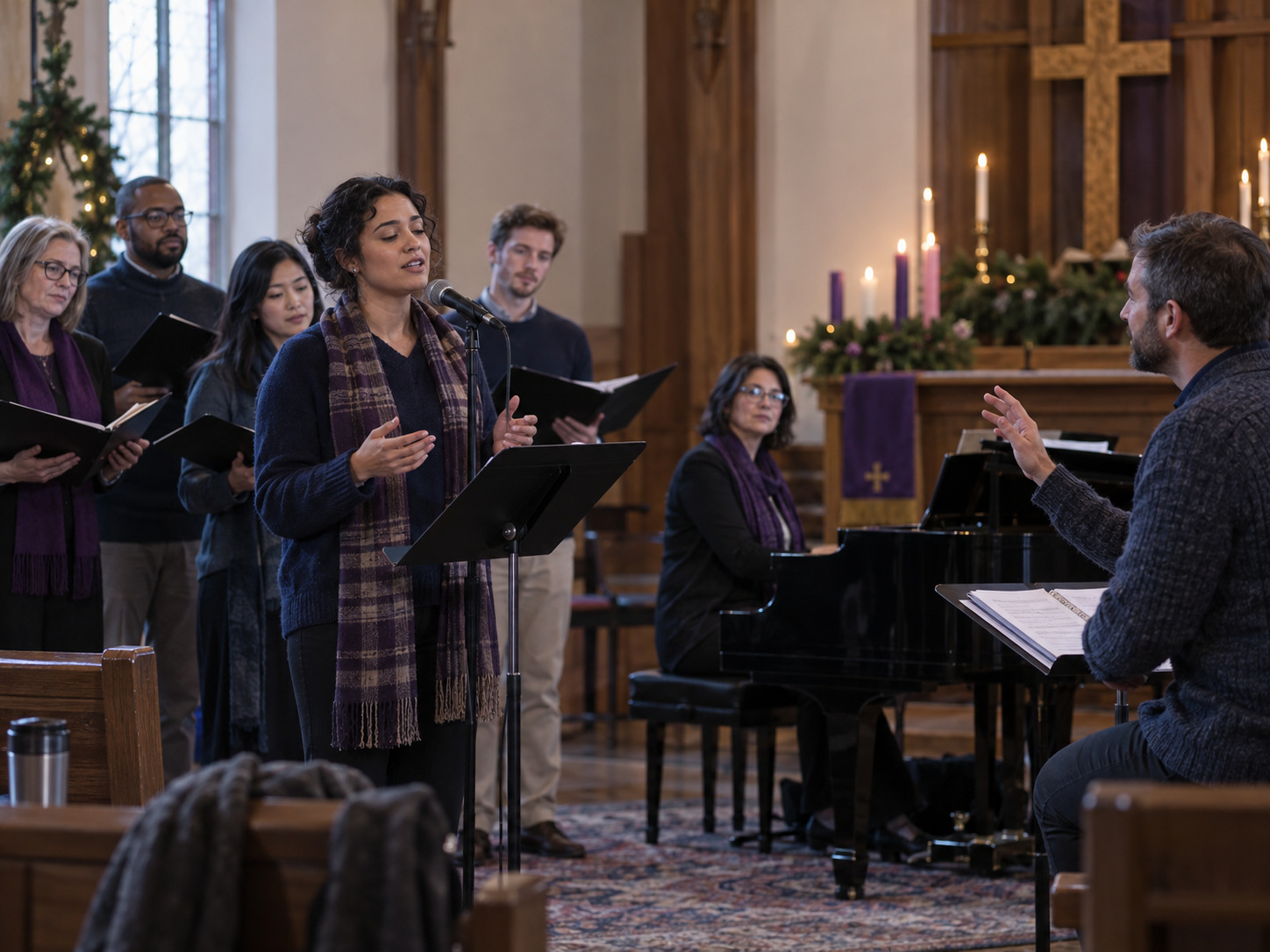
The short answer: choose the key by singing the complete hymn, then rehearse the recorded rubato as a map of musical landmarks rather than a tempo the soloist can reshape at will. “O Come, O Come, Emmanuel” needs space, but that space must already be shared by the singer, worship leader, and playback operator.
The Spiritrax “O Come, O Come, Emmanuel” backing track is available in D minor, E minor, B minor, and G-flat minor. Its arrangement uses solo piano, brass, and percussion with a spacious, rubato character designed for solo performance. Those qualities can make the hymn feel contemplative and expectant, but they also require careful preparation before an Advent service.
Choose the key with the entire hymn
Do not choose a key from the first phrase or from the version a singer already knows. Sing every verse planned for the service with the actual track.
Compare the keys by asking:
- Does the lowest phrase stay present and understandable?
- Can the singer sustain the highest section without bracing?
- Does the repeated refrain remain clear after several verses?
- Can the soloist still shape the text at the end of the hymn?
- Does the microphone support the voice without requiring excessive volume?
The most dramatic key is not automatically the best one. A useful key lets the singer stay vocally and spiritually present through the complete service moment.
Once the key is chosen, remove the rejected versions from the active rehearsal and service playlists. Similar filenames are an avoidable source of uncertainty for a volunteer operator.
Learn the rubato that is already in the recording
A live accompanist can follow a singer’s breath. A backing track cannot. The arrangement may feel free, but its timing is fixed inside the file.
Listen without singing and mark several landmarks:
- the first sound and the first dependable entrance cue;
- the point where the piano phrase begins to open;
- each arrival into the refrain;
- any instrumental space between verses;
- the final cadence and length of the ending.
Ask the soloist to breathe with those landmarks before adding text. The goal is not to count every moment mechanically. It is to know where freedom exists inside the recorded shape and where the next musical event will arrive whether or not the singer feels ready.
If a phrase repeatedly feels crowded, diagnose the exact cause. The singer may be taking a late breath, carrying a consonant too long, or starting the previous phrase too slowly. Solve that musical decision before assuming the track itself needs to change.
Let anticipation shape the phrases
This Advent hymn does not need to sound emotionally identical from beginning to end. Give each verse and refrain a clear purpose.
One simple plan is:
| Section | Musical job |
|---|---|
| Opening verse | Establish longing with clear, unforced text |
| First refrain | Offer a measured lift without breaking the contemplative tone |
| Middle verse | Deepen the prayer through warmer color and more direct focus |
| Final refrain | Widen the sound while preserving clarity and restraint |
The plan should fit the congregation’s service and the number of verses being used. A small chapel may remain intimate throughout. A larger sanctuary may allow the final refrain to broaden. What matters is that the growth comes from meaning, not from automatic volume.
Speak the text before singing and identify one active word in each phrase. Then sing while allowing that word—not every syllable—to carry the phrase forward.
Rehearse the first entrance before the whole hymn
The opening seconds shape the congregation’s trust in the moment. Rehearse the actual transition into the track rather than beginning from a convenient playback position.
Decide:
- who gives the operator permission to start;
- whether the soloist is already at the microphone;
- what the singer listens for before entering;
- whether a spoken introduction, reading, or prayer comes immediately before the music;
- and how much silence belongs between the spoken moment and the first note.
Run that handoff three times. Each pass should begin with the preceding service action. A clean entrance depends as much on the cue between people as it does on the singer’s musical preparation.
Avoid vague directions such as “start when it feels right.” Use a visible nod, a named final word, or a clear service-order cue that a volunteer can repeat.
Keep the refrain from becoming rushed or over-sung
The refrain brings release, but release does not require sudden speed or force. The singer should know where the accompaniment expands and how the breath fits that expansion.
Rehearse the refrain in three ways:
- Speak it in the track’s rhythm while taking the planned breaths.
- Sing it at a restrained dynamic while staying inside the recorded timing.
- Add the service-level dynamic without changing the tempo or swallowing the text.
If the final consonants disappear when the sound grows, lower the track slightly or ask the singer for clearer releases before adding more microphone level. The congregation needs to understand the words more than it needs to experience a dramatic wall of sound.
Decide how the room participates
The Spiritrax arrangement is well suited to a solo feature, but the service still needs a participation plan.
The congregation may:
- listen throughout;
- join only on a familiar refrain when the worship leader has clearly invited that response;
- follow printed or projected text silently;
- or receive the hymn as a musical response after a reading or prayer.
Do not assume people will know when to join a rubato arrangement. If congregational singing is part of the plan, rehearse a visible cue and confirm that the selected key and timing are comfortable for ordinary voices. A soloist’s best key may not be the congregation’s best key.
For a choir or small ensemble supporting the soloist, assign a limited job. They might enter on a selected refrain or provide a simple unison response. Avoid adding untested harmony or movement that competes with the spacious accompaniment.
Place the hymn where silence can remain part of it
This track can support several Advent moments:
- an opening call to worship;
- a response after a prophetic reading;
- a candle-lighting or reflective transition;
- a solo during prayer or preparation;
- or a quiet bridge into the next spoken part of the service.
Choose the placement by what comes before and after. A reflective arrangement may lose its purpose if it is placed between two crowded announcements or followed immediately by an unrelated high-energy cue.
The ending needs a plan too. Decide whether the room remains silent, a reader begins, the worship leader prays, or another musical element follows. Mark the length of the final ring and rehearse the next person’s entrance after it.
For broader seasonal planning, the Spiritrax Christmas collection includes this hymn alongside other familiar Christmas accompaniment tracks. Use collections to build a coherent service only when each piece has a distinct role.
Balance piano, brass, percussion, and voice in the real room
The arrangement’s wide space can change character through sanctuary speakers. Brass may feel larger, percussion may become more prominent, and piano detail may disappear in a reverberant room.
Test the actual file through the service system. Listen from the front, center, and rear of the room for:
- whether the first piano cue is audible to the singer;
- whether the brass covers the words at fuller moments;
- whether percussion makes the rubato feel more rigid than expected;
- whether the microphone keeps quiet phrases intelligible;
- and whether the ending rings long enough to support the planned silence.
The singer may need a slightly different monitor balance from what the congregation hears. Give the soloist enough of the musical landmark they use for entrances without making the house mix unnaturally loud.
Give the operator one complete service cue
Prepare a note with:
| Detail | What to record |
|---|---|
| File | Exact title, selected key, and approved filename |
| Start | Spoken line, nod, or service action that releases playback |
| First entrance | The audible cue the singer follows |
| Participation | Solo, choir response, or congregation plan |
| Ending | Final ring, silence, prayer, reading, or next cue |
| Backup | Location of the same verified file on a second tested device |
Download the final performance file locally. Do not rely on a product preview or live internet connection during the service. Silence notifications, connect power, and test the same cable, mixer input, speaker path, and backup device the operator will use.
A focused Advent rehearsal sequence
Use this order:
- Sing the complete planned hymn in the likely keys.
- Choose one key and remove alternatives from the live folder.
- Listen without singing and mark the recorded rubato landmarks.
- Speak the text with the planned breaths.
- Rehearse the first entrance from the preceding service action.
- Shape each verse and refrain around a distinct purpose.
- Decide whether the congregation or ensemble participates.
- Sound-check the quiet opening, fullest refrain, and final ring.
- Run the complete handoff into the next prayer, reading, or cue.
Finish with the exact soloist, worship leader, operator, file, and device intended for the service.
Frequently asked questions
Which key is best for “O Come, O Come, Emmanuel”?
There is no universal best key. Spiritrax offers D minor, E minor, B minor, and G-flat minor. Sing every planned verse with the actual soloist and choose the version that keeps both the lowest and highest phrases clear without strain.
Can a singer take extra time with a rubato backing track?
Only where the recording already provides that space. The file’s timing is fixed, so the singer must learn its landmarks and place breaths inside that shape.
Should the congregation sing with this arrangement?
It can, but the solo-oriented rubato requires a clear invitation, a comfortable key, and visible leadership. Listening may serve the moment better when the timing is too flexible for unrehearsed group singing.
How should the service end the track?
Let the final cadence complete, then follow the planned silence or spoken cue. Rehearse the next person’s entrance so the ending is neither cut off nor left uncertain.
Can live musicians play along?
They can when each person has a defined role and follows the exact recorded timing. Test the combined texture in the room so added instruments do not obscure the soloist or the track’s musical landmarks.
The useful test
At the end of rehearsal, the soloist should be able to enter from the real service cue, follow the recording’s rubato without chasing it, carry every verse in the chosen key, and leave the final silence undisturbed. When the singer, worship leader, operator, and room all share that map, the hymn can feel spacious without ever feeling uncertain.
Preview the O Come, O Come, Emmanuel backing track in D minor, E minor, B minor, and G-flat minor, then choose the key and rubato map your soloist can carry through the complete service moment.
Preview the Available Keys