
Let “O Worship the King” Move in Two Strong Beats
Worship Music & Hymn Resources
By Spiritrax Content Studio · October 8, 2026
Updated October 8, 2026
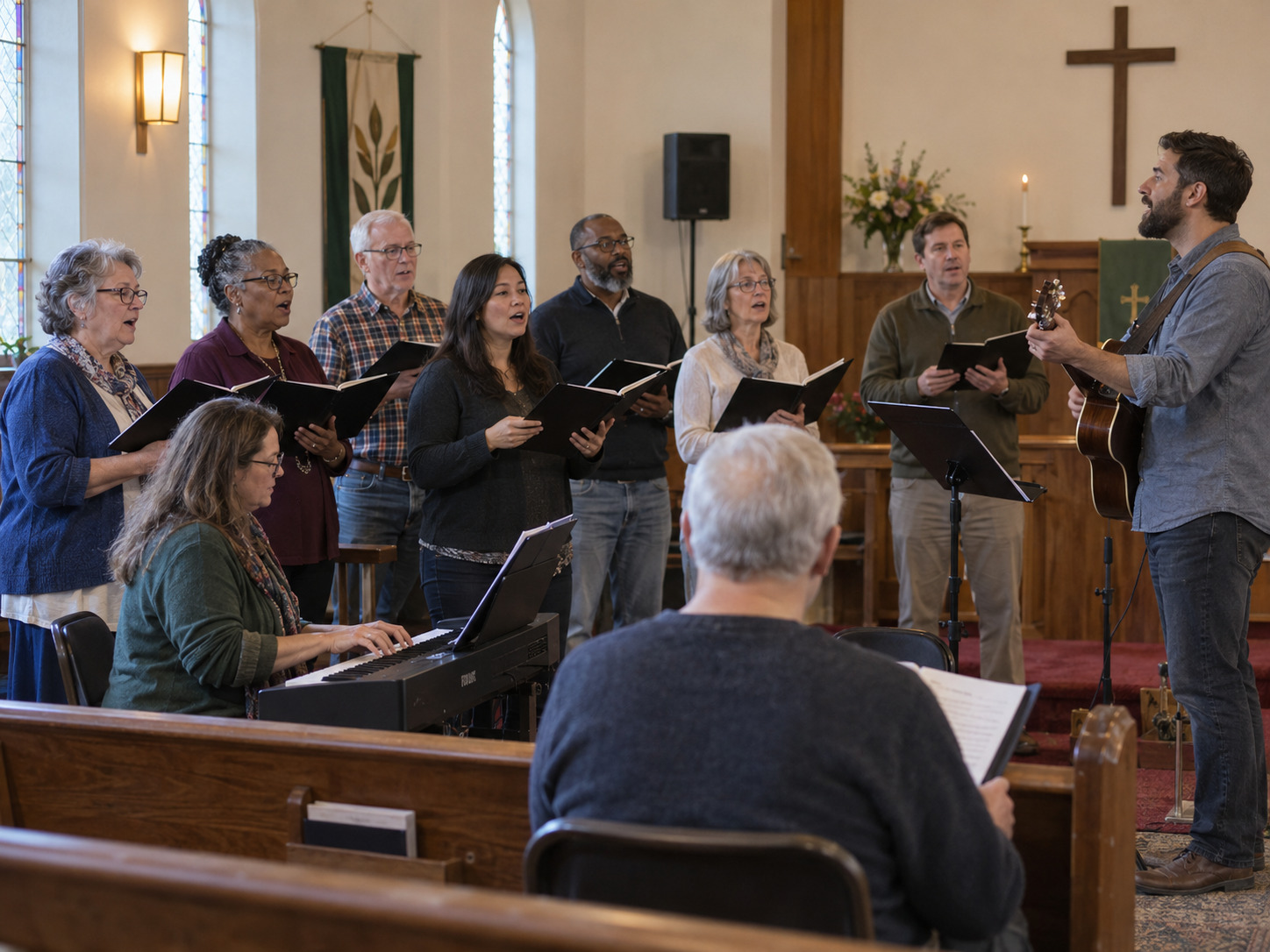
The short answer: rehearse “O Worship the King” by feeling the 6/8 pulse in two large beats, choosing a key the congregation can sustain, and planning the open third verse before the arrangement begins to build. The hymn should feel spacious and confident, not heavy or rushed.
Spiritrax’s contemporary arrangement uses acoustic guitars, bass, drums, piano, and synths. The first two verses carry a 6/8 feel, then the third verse opens before building toward the final chorus. That shape gives a worship team useful contrast, but it also requires the leader, singers, sound operator, and playback operator to agree on the musical map.
Feel 6/8 as two, not six
The easiest way to make a 6/8 hymn feel stiff is to count every eighth note with equal weight. Instead, feel two broad pulses in each measure: one at the beginning and one halfway through. The smaller notes live inside those larger motions.
Start rehearsal away from the microphones. Have the leader and singers sway, step, or tap only the two main beats while the track plays. Then speak the opening words in that pulse. When the group can feel the larger shape, sing the melody without trying to make every syllable equally strong.
The result should move gently forward. If the choir drags, check whether singers are waiting for every instrumental detail. If they rush, ask them to breathe through the second large beat rather than treating it as a launchpad into the next phrase.
Choose the key with the whole hymn
The Spiritrax “O Worship the King” backing track is available in G, A, C, and E major. Do not choose only from the first line. Sing enough of the complete arrangement to test where the melody sits after the voices have warmed and the music has grown.
Use three questions:
- Can ordinary mixed voices enter the opening comfortably?
- Can the congregation sustain the middle of the melody without pressing?
- Does the final build still sound like worship rather than a vocal test?
If a soloist or small worship team will lead while the congregation listens, their best key may differ from the most singable congregational key. Decide who is actually expected to sing each section before choosing.
For a mixed room, compare the keys with several representative voices instead of asking only the strongest soprano or tenor. The right key is the one that lets the most people carry the complete hymn with a steady tone and understandable words.
Map the arrangement before adding leadership cues
Listen through the track once without singing and mark the major sections:
- introduction;
- first verse in the established 6/8 feel;
- second verse with the same underlying pulse;
- open third verse;
- the build toward the final chorus;
- ending and service transition.
Now assign one person to call each important cue. In a small church, that may be the same worship leader throughout. In a choir-led service, the director may cue the singers while the playback operator follows the printed order.
Do not rely on everyone “feeling it” in the moment. Name what the group hears before each entrance: a drum pattern, guitar pickup, piano change, held chord, or the leader’s visible breath. A cue is dependable when the team can describe it and reproduce it.
Let the open third verse actually open
An open verse creates space by changing texture, not by losing direction. Decide what will become simpler. You might reduce the number of singers, soften the delivery, let the congregation listen briefly, or have one section carry the melody while the rest supports lightly.
Avoid adding extra spoken material simply because the arrangement feels spacious. First rehearse the musical transition as written. If the service needs prayer or a short spoken cue, place it only after confirming that it will not cover an instrumental entrance or force the next singer to guess.
The open verse is also a useful place to protect the text. Ask singers to use a unified vowel, a shared final consonant, and one clear direction through each phrase. A quieter texture exposes uncertain cutoffs, so rehearse the releases with as much care as the entries.
Build the final section without rushing
When drums, bass, keyboards, and voices grow together, the ensemble may mistake increased energy for a faster tempo. Keep the two-beat 6/8 feel physically visible. The leader’s gesture can become larger without becoming quicker.
Run only the transition into the build several times. Begin a few measures before the texture changes and continue through the first full phrase after it. Ask the team to listen for the instrumental layer that confirms the build has arrived.
Then decide what “bigger” means in your room. It may mean more voices, stronger consonants, a wider dynamic range, or a fuller band mix. It does not automatically mean more microphone gain. Make one change at a time and listen from the congregation’s seating area.
Plan leadership verse by verse
Write the leader for each section in the service order. A practical plan might look like this:
- the worship leader gives the first entrance;
- choir and congregation share the first two verses;
- a smaller group carries the open third verse;
- the worship leader visibly invites the congregation into the final build;
- the playback operator watches one named person for the ending.
This is more reliable than telling everyone to “follow the music.” The track provides consistency; human leadership tells the room how to participate.
If the hymn is part of a Thanksgiving service, keep the placement focused. Spiritrax’s guide to choosing Thanksgiving music the congregation can carry recommends a small, purposeful set rather than filling every service moment with seasonal music. “O Worship the King” can carry praise, gratitude, protection, and abundance without needing a long introduction.
Balance the track for participation
Test the purchased file through the same sound system the service will use. Stand where congregants sit and listen for three things:
- Is the pulse clear enough for people to enter?
- Can singers hear the harmonic support without fighting the track?
- Does the final build leave room for the room itself?
A backing track that sounds exciting in headphones may need a different balance through sanctuary speakers. Check bass buildup, drum presence, and whether keyboards mask the vocal range. Lowering one source may improve participation more than raising every microphone.
Use the same playback file in rehearsal and worship. Name it clearly, download it before the service, and keep a backup on a second device. For a fuller preparation sequence, use this church sound-check backing-track checklist.
A 25-minute rehearsal plan
Minutes 0–4: establish the two-beat pulse
Listen and step the main beats. Speak the opening words in rhythm before singing.
Minutes 4–9: compare keys
Test the opening, a middle phrase, and the final build in the most likely keys. Choose for the people who will sing the whole hymn.
Minutes 9–13: mark the arrangement
Identify the introduction, first two verses, open third verse, build, and ending. Write the cues.
Minutes 13–18: rehearse the open verse
Choose the vocal texture, entrance leader, dynamic, and release. Keep it spacious without becoming uncertain.
Minutes 18–22: rehearse the build
Loop the transition into the final section. Keep the pulse steady as the sound grows.
Minutes 22–25: run the service handoff
Start from the moment before playback and continue through the sentence, prayer, or transition that follows the ending.
Common problems and practical fixes
The hymn feels like a slow march
Stop counting six equal subdivisions. Return to two broad pulses and let the melody travel across them.
The congregation enters tentatively
Make the leader’s breath and gesture visible, and confirm the instrumental pickup everyone should hear.
The open verse loses energy
Simplify the texture, not the intention. Give one singer or section responsibility for carrying the phrase.
The final build rushes
Keep the leader’s gesture wider but not faster. Rehearse the transition with the rhythm section and playback track before adding all voices.
The track overwhelms the room
Listen from the seating area and reduce the masking instrument range before increasing vocal microphones.
FAQ: “O Worship the King” backing tracks
Which keys are available?
Spiritrax offers this arrangement in G, A, C, and E major. Compare keys with the people expected to sing the complete hymn.
What makes this arrangement contemporary?
It uses acoustic guitars, bass, drums, piano, and synths while retaining the classic hymn. The first two verses have a 6/8 feel, and the open third verse builds into the final chorus.
Is it suitable for Thanksgiving?
Yes. The song’s themes include praise, protection, love, abundance, and gratitude. Place it where the service needs a clear act of shared praise rather than adding it only because it is seasonal.
Should the congregation sing the open third verse?
They can, but it is not required. Decide whether that verse belongs to the whole room, the choir, a small group, or a solo leader, then make the invitation unmistakable.
Do we need to rehearse the ending if the file is fixed?
Yes. A fixed ending still needs a visible release, a playback stop plan, and a clear transition into the next service element.
The strongest performance will not call attention to the technology. It will let the congregation feel the pulse, understand the invitation, and join the hymn with confidence. Choose the key carefully, rehearse the open verse and final build, and let one shared musical map support the whole room.
Preview G, A, C, and E major, then choose the version your worship leader, choir, and congregation can carry through the 6/8 pulse, open third verse, and final build.
Preview the Four Keys