
Rosh Hashanah Music Needs Space for Prayer, Singing, and the Shofar
Holiday & Special Occasion Music
By Spiritrax Content Studio · July 30, 2026
Updated July 30, 2026
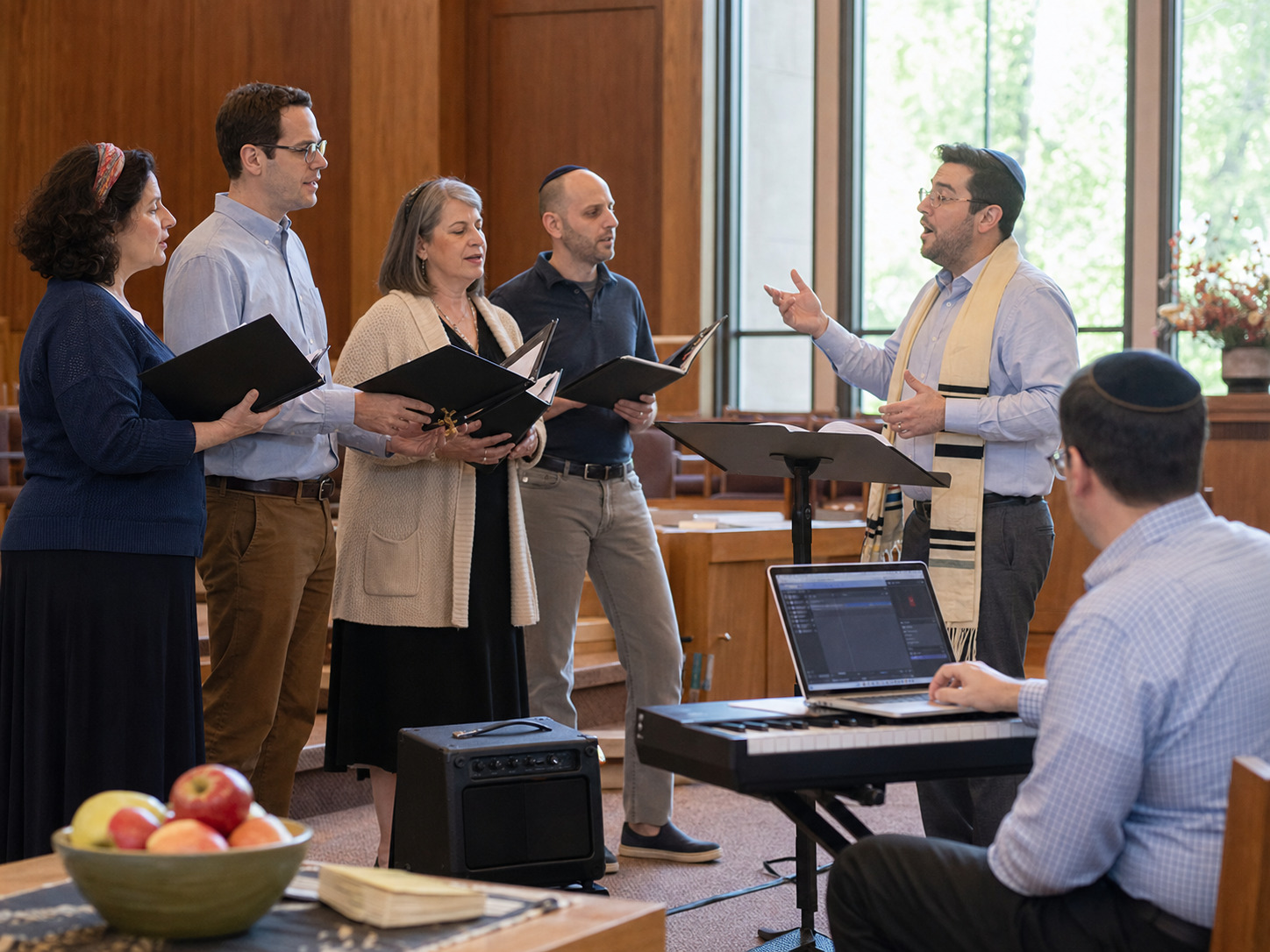
Rosh Hashanah music serves the gathering best when it supports prayer, memory, participation, and reflection without crowding them.
That starts with the congregation’s own practice. Traditions, melodies, language, choir roles, instrumentation, and expectations vary. The rabbi, cantor, worship leader, or music director should decide what belongs in the service. A backing track is then a practical support: it can provide a dependable arrangement, help a soloist rehearse, or give a small ensemble a stable musical foundation.
The goal is not to make every moment larger. It is to help each musical moment do its real work.
Begin with the service, not a playlist
Before choosing an arrangement, write down:
- where music is already part of the congregation’s service order;
- which melodies are familiar and expected;
- which moments belong to cantor, choir, soloist, children, or the whole congregation;
- whether accompaniment is customary in that community and setting;
- how much rehearsal time is available; and
- who has final responsibility for liturgical and musical decisions.
This prevents a beautiful track from being placed where it does not belong. It also protects the congregation’s established musical language instead of replacing it with a generic holiday program.
Give every musical moment one clear role
A simple planning table helps the team choose texture and playback behavior.
| Musical role | What the room may need | Backing-track question |
|---|---|---|
| Gathering or pre-service | A calm, welcoming atmosphere | Should this stay instrumental and unobtrusive? |
| Cantor or solo feature | Support for text, phrasing, and breath | Is the key comfortable and the introduction clear? |
| Choir response | A stable pulse and shared entrance | Do sections have enough cue information to sing independently? |
| Congregational song | Familiarity, singability, and room to participate | Is the arrangement simple enough to follow? |
| Reflective transition | Space between spoken or ritual moments | Should the ending resolve, hold, or fade before speech? |
| Closing or community song | A clear sense of sending and connection | Does the final texture fit the service’s emotional arc? |
Not every service needs all six roles. Fewer, well-placed musical moments usually serve the gathering better than a crowded sequence.
Protect the congregation’s familiar melodies
High Holy Day music carries memory. A melody may be connected to family, place, community, or years of shared worship. If the congregation already knows a setting, treat that knowledge as an asset.
Before adopting a track:
- compare its melody and form with the version your community sings;
- confirm the language and verses the leader plans to use;
- check whether the introduction gives the expected starting pitch;
- listen for repeats, interludes, and endings; and
- ask whether the arrangement leaves enough room for communal singing.
If the form differs, do not assume singers will adapt in the moment. Mark the difference, teach it deliberately, or choose a closer arrangement.
Let the shofar have its own space
The shofar is not a production effect and does not need a backing track underneath it. Protect the silence, attention, and timing around that part of the service according to the congregation’s practice.
From a playback perspective, this means the preceding musical file needs an intentional ending. Avoid an automatic crossfade, lingering loop, or notification sound. The operator should know exactly when the track is finished and when the room belongs to the next ritual moment.
Choose a key for the actual singer and room
The familiar recording is not automatically the correct key.
Test the complete vocal range, not only the opening phrase. Notice:
- the highest sustained note;
- the lowest quiet entrance;
- the place where the text needs the clearest diction;
- whether the singer must lead a congregation after the solo; and
- how the room responds at the intended microphone level.
For a choir, test the transition from rehearsal support to independent singing. A guide vocal can help people learn the line, but it should not remain so prominent that the choir follows a recorded singer instead of its conductor or cantor.
If a transposition is needed, confirm it before the final service rehearsal so every reference file, lead sheet, and accompaniment version agrees.
Build a rehearsal sequence that removes support gradually
Backing tracks are most helpful when they create confidence without creating dependence.
Rehearsal 1: learn the map
Use the most supportive available version. Mark the introduction, first entrance, repeats, interludes, tempo changes, and ending. Speak the cues aloud.
Rehearsal 2: sing without the recorded lead
Move to accompaniment-only playback. Check whether the cantor, choir sections, or soloist can carry the melody and text without following a guide voice.
Rehearsal 3: connect music to the service
Practice the spoken introduction, walk to the microphone, track start, final cutoff, silence, and next spoken or ritual moment. This is where a technically correct arrangement becomes service-ready.
Final check: use the real equipment
Rehearse from the same device, output, speaker or sound system, and file order planned for the gathering. Download the files locally and keep a second local copy.
Prepare a cue sheet that a second person can follow
Even when one trusted person usually runs playback, write a clear cue sheet.
For each file, include:
- service location;
- exact filename;
- guide-vocal or accompaniment role;
- start cue;
- whether the leader speaks over the introduction;
- volume note;
- ending behavior;
- next service action; and
- who may stop or restart the track.
Name files in service order, such as 01-gathering, 02-choir-response, and 03-closing. Keep test recordings, alternate keys, and rehearsal mixes outside the final service folder.
Use accompaniment respectfully
Technology should stay in the background of a sacred gathering.
- Keep phones and laptops in do-not-disturb mode.
- Turn off shuffle, crossfade, autoplay, and system sounds.
- Avoid visible searching or browsing during the service.
- Use only music and recordings the congregation is authorized to use.
- Confirm pronunciation, text, and musical tradition with the appropriate leader.
- Do not let a fuller arrangement pressure the community into a tempo or emotional tone that does not fit.
The best playback is usually the playback no one has to think about.
FAQ: Rosh Hashanah music with backing tracks
Can a small congregation use a backing track?
Yes, when accompaniment fits the congregation’s practice and the service leader approves it. A track can support a cantor, soloist, choir, children’s group, or community song without requiring a full instrumental ensemble.
Should every vocal number use a guide vocal?
No. Guide vocals are useful for learning. For the service, accompaniment-only playback usually gives the live leader and singers clearer musical ownership.
How early should the team begin?
Start early enough to confirm repertoire, tradition, text, key, arrangement form, and permissions before the final weeks. The service-order rehearsal should not be the first time the team hears the accompaniment-only version.
What if the track form differs from our melody?
Do not force the familiar community practice into an unfamiliar form at the last minute. Teach the difference deliberately, request an appropriate adjustment where available, or choose an arrangement that follows the version the congregation knows.
Is an instrumental track appropriate under the shofar?
That decision belongs to the congregation’s rabbi, cantor, or service leader. From a musical-planning standpoint, avoid assuming that silence needs to be filled. Give sacred and ritual moments the space your community expects.
The takeaway
Plan Rosh Hashanah music from the service outward. Protect the congregation’s familiar melodies, assign every selection a clear role, choose keys for the real singers, move from guide support to independent singing, and rehearse the transitions around the music—not only the music itself.
The Spiritrax Jewish Music Collection brings together accompaniment and guide-vocal resources that can support cantors, soloists, choirs, families, and community music when the selections fit your congregation’s practice.
Explore the Jewish Music Collection