
Schubert or Bach/Gounod? Choose the Ave Maria Your Singer Can Carry
Worship Music & Hymn Resources
By Spiritrax Content Studio · July 27, 2026
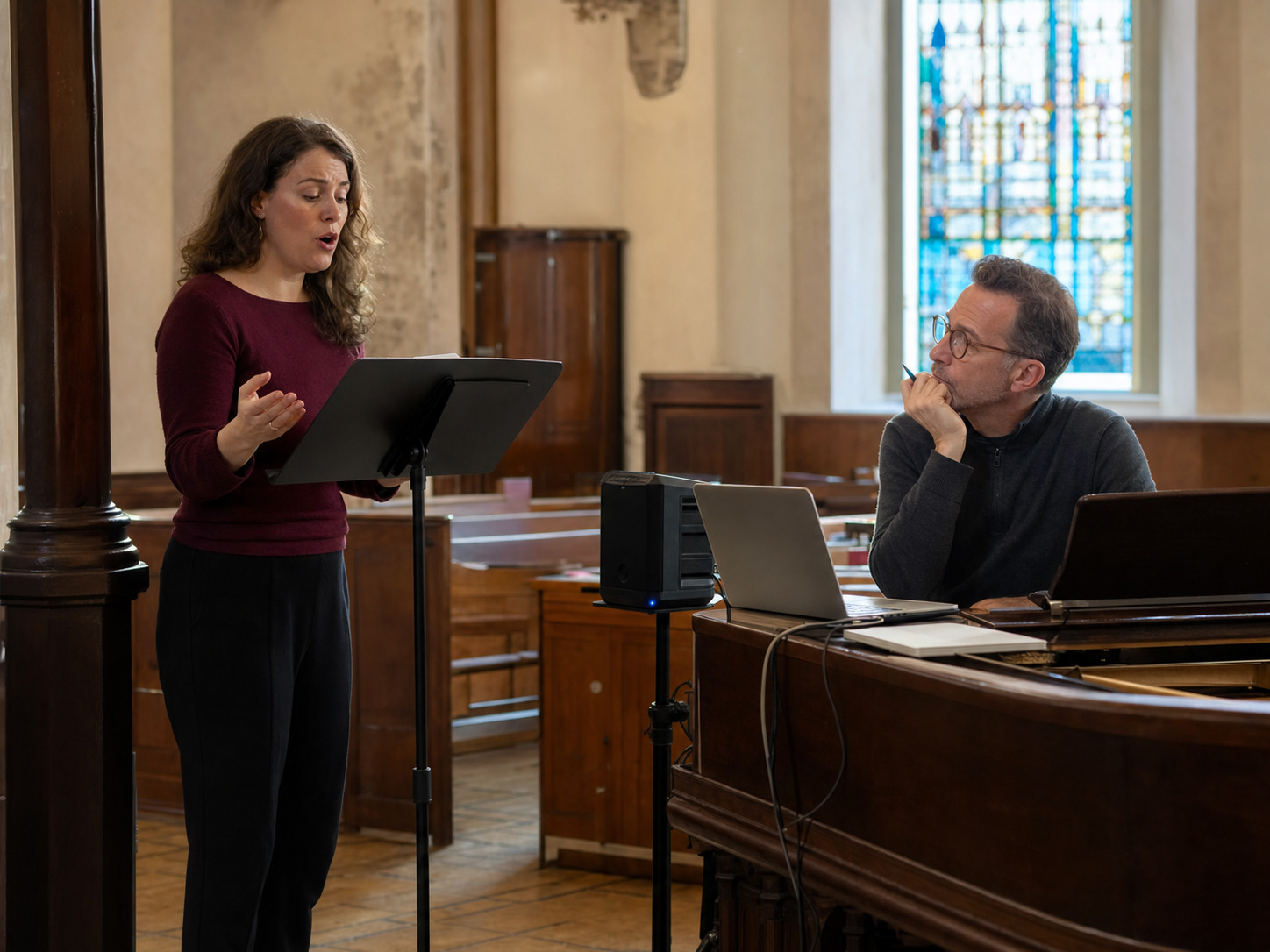
“Ave Maria” can mean two very different musical experiences before anyone has chosen a key.
Schubert's setting unfolds as a lyrical song with a broad, flowing piano part. The Bach/Gounod setting places Gounod's melody over the harmonic pattern of Bach's Prelude No. 1. Both can support a soloist in worship, a wedding, a memorial, a recital, or another formal ceremony. They do not ask the singer or the room to do the same work.
Choose the setting first. Then choose the arrangement, key, repeat plan, and playback cues around the actual singer and event.
The short answer
Choose Schubert when the singer connects naturally to its long melodic line and the moment benefits from a song-like arc.
Choose Bach/Gounod when the singer prefers its more even, continuous flow over the repeating prelude pattern, or when that familiar setting better matches the planned service or ceremony.
That is a musical starting point, not a rule. The right choice is the version the singer can phrase comfortably and the coordinator can place clearly.
Compare the musical jobs
| Question | Schubert | Bach/Gounod |
|---|---|---|
| Underlying shape | A self-contained art song, also known as Ellens Dritter Gesang | Gounod's vocal melody placed over Bach's Prelude No. 1 in C major |
| Accompaniment feel | Flowing piano writing that follows the song's larger rise and release | A steady harmonic pattern that keeps the accompaniment moving continuously |
| Singer's main task | Sustain line, breath, text, and the long musical arc | Place the melody calmly over an even accompaniment pattern |
| Planning detail to confirm | Which key and text setting the singer will use | Which arrangement, instrumentation, key, and number of melody passes |
| Best rehearsal question | Can the singer carry the full line without rushing the arrival points? | Can the singer remain free and expressive without leaning against the repeating pattern? |
Do not decide only from the title. Listen to the exact accompaniment the singer will use.
Know which Bach/Gounod arrangement is in the folder
The current Spiritrax Songs & Arias catalog lists two Bach/Gounod versions.
- Ave Maria v. 1 is a solo-piano accompaniment with the complete melody once through.
- Ave Maria v. 2 uses piano, organ, and cello, and repeats the melody twice.
Those are not interchangeable on an event plan. A repeated melody changes the duration, breath strategy, text plan, and cue into whatever comes next. The added instruments also change the color and the amount of space the singer feels around the line.
Write the exact version number on the service or ceremony plan. If the team expects one pass and the file contains two, the problem will not be solved by turning the volume down.
Choose the key after singing the whole piece
The familiar opening can make a key feel comfortable before the more demanding phrases arrive.
Test:
- the first entrance after the introduction;
- the longest phrase;
- the highest sustained note;
- the approach to the final section;
- and the final line after the singer has already carried the full piece.
The Spiritrax Schubert Ave Maria page currently offers accompaniment-key choices and identifies a guide vocal in B-flat. The Songs & Arias page lists the Bach/Gounod versions in F, C, and A-flat.
Use the product preview to compare, but make the final key decision with the complete melody and the actual singer. A key that produces one impressive note but leaves the rest of the piece tense is not the comfortable choice.
Do not copy a famous recording's tempo
The singer needs enough motion to carry the line and enough space to shape the text.
When the tempo is too slow:
- breath demands grow;
- phrases can lose direction;
- the accompaniment may feel heavier than intended;
- and the ending can arrive without momentum.
When it is too fast:
- consonants become rushed;
- long phrases lose room;
- entrances feel less settled;
- and a reverent moment can start to sound procedural.
Rehearse with the exact track rather than tapping a tempo from memory. A backing track will remain steady, so the singer should know where the accompaniment moves and where the phrase must move with it.
Plan the introduction
The first vocal entrance often feels exposed because the room is still becoming quiet.
Before the event:
- play the full introduction;
- decide when the singer takes position;
- identify the pitch and rhythm that lead into the first phrase;
- test whether the operator starts before or after a spoken cue;
- repeat the entrance without stopping the accompaniment early.
The singer should not be listening for a vague feeling. Name the accompaniment landmark that makes the entrance reliable.
If a coordinator, worship leader, officiant, or family representative is involved, keep the instruction simple: “After the reading, leave a short silence; the operator starts the track; the singer enters after the full introduction.”
Decide where the piece belongs
The music should support the planned moment rather than force the event to reorganize around the track.
Useful questions include:
- Is the piece a solo that people will listen to, or will it sit under another action?
- Does the room need silence before the first chord?
- Will the singer be visible to the operator?
- Is there a reading, prayer, procession, reflection, or transition immediately before or after it?
- Does the venue or faith community have its own music guidelines?
- Will the event be recorded or livestreamed?
Confirm placement and permissions with the appropriate venue, music director, faith leader, coordinator, rights source, and platform. A downloadable accompaniment track does not by itself answer every public-performance, recording, streaming, lyric, or ceremony-policy question.
Give the operator a complete cue
The playback note should include:
- exact title and composer/setting;
- version or arrangement;
- key;
- filename;
- start cue;
- whether the file plays once or repeats the melody;
- ending type;
- the words or action that follow;
- and the backup-file location.
Use a filename such as:
AveMaria_BachGounod_v2_KeyF_TWO-PASSES.mp3
or:
AveMaria_Schubert_KeyDb_FINAL.mp3
Keep only the approved file in the live event playlist. Save the master download and alternate keys in a separate rehearsal folder.
Rehearse in the real room
A church, chapel, recital hall, funeral home, outdoor ceremony, and small studio will not return sound in the same way.
Test from the singer's position and listen from the seating area.
- Can the singer hear the introduction?
- Does the track cover the live voice?
- Does the piano or ensemble color become harsh through the speaker?
- Is the cable or wireless connection stable?
- Does the final chord have time to decay before anyone speaks?
- Is a microphone needed, and has it been tested at the real distance?
Download the file locally. Silence notifications. Bring a charged backup device and a tested cable or adapter. A beautiful arrangement still needs ordinary playback preparation.
A two-pass rehearsal
Use the first pass to solve music:
- key;
- text and diction;
- breath;
- tempo relationship;
- entrance;
- peak;
- ending.
Use the second pass to solve the event:
- spoken cue before the track;
- singer position;
- microphone distance;
- playback volume;
- sightline to the operator;
- silence after the ending;
- transition into the next action.
Do not spend every rehearsal polishing the middle while leaving the first and last 20 seconds to chance.
Checklist before the event
- Confirm Schubert or Bach/Gounod.
- Confirm the exact arrangement and instrumentation.
- Write down whether the melody plays once or twice.
- Test the entire piece in the chosen key.
- Rehearse with the final track at its steady tempo.
- Name the first-entrance landmark.
- Give the operator the exact filename and start cue.
- Test volume, microphone, cable, and speaker in the real space.
- Keep the approved file separate from alternate versions.
- Download a local backup.
- Confirm venue, ceremony, recording, streaming, and other permissions separately.
FAQ: choosing an Ave Maria backing track
What is the main difference between Schubert and Bach/Gounod Ave Maria?
Schubert's setting is a self-contained song with its own flowing piano accompaniment. Bach/Gounod places Gounod's vocal melody over the harmonic pattern of Bach's Prelude No. 1. Singers should compare the exact arrangements, not only the shared title.
Which Ave Maria is better for a wedding or memorial?
The better choice is the setting accepted by the venue or faith community and suited to the singer, planned moment, key, duration, and arrangement. Confirm local guidelines rather than assuming one version is always preferred.
Why does the number of melody passes matter?
A second pass changes the duration, text plan, breath strategy, and transition into the next event element. Spiritrax's current Bach/Gounod v. 1 plays the melody once; v. 2 repeats it twice.
Should the singer use the original key?
Not automatically. Test the full piece and choose a key that lets the singer sustain the line, text, and ending comfortably.
Can the track play under spoken words?
Only when the arrangement, volume, event plan, and venue guidance support that use. For many formal or reverent moments, a clearly placed solo and intentional silence are better than continuous background music.
The takeaway
Choose the Ave Maria by listening to the singer, the exact arrangement, and the job the music must do. Confirm the setting, key, repeat plan, introduction, ending, and operator cue before the event. When those decisions are settled, the singer can carry the line and the room can stay present.
Prepare Schubert’s Ave Maria with a downloadable accompaniment track in a key that fits the singer, then rehearse the entrance, pacing, and ending in the real space.
Choose a Schubert Ave Maria Track